
A JCT contract is one of the standard-form building contracts published by the Joint Contracts Tribunal (JCT) and widely used on UK construction projects. Each one sets out who designs, how and when the contractor is paid, how changes and delays are handled, and what happens if things go wrong. The current edition is JCT 2024.
Updated November 2026. Covers JCT 2024 and the end of JCT 2016 sales on 31 December 2026. General information for England and Wales, not legal advice. Check your own contract and its schedule of amendments, and take advice on anything that matters.
What is a JCT contract?#
JCT stands for the Joint Contracts Tribunal. It has produced standard forms of construction contract since 1931 and has been a limited company since 1998. Its members are Build UK, the Contractors Legal Group, the Local Government Association, Real Estate:UK, the RIBA, the RICS and the Scottish Building Contract Committee. Clients, consultants, contractors and specialists all have a seat, so the forms are written by the industry rather than by one side of a deal.
The contracts are published for JCT by Thomson Reuters (Sweet & Maxwell). You buy them as printed copies or through JCT On Demand, the online version you fill in and print. They are not free, and the wording is copyright.
Open any JCT contract and you'll find the same shape:
- The Agreement: the Recitals (what the job is), the Articles (who the parties and key people are) and the Contract Particulars.
- The Conditions: the standard clauses, the same on every job using that form.
- Schedules: optional extras such as fluctuations, bonds or a contractor's design submission procedure.
The Contract Particulars are the part someone fills in, and they hold most of the terms that decide your cash flow: the first interim valuation date and how often valuations happen, the retention percentage, the rate of liquidated damages, the rectification period, the insurance option and who nominates an adjudicator. If you only have time to read one part, read that.
"It's a JCT" rarely means the standard terms. Most main contractors send a JCT sub-contract with a schedule of amendments, and the amendments are where payment periods get longer, set-off gets wider and notice conditions get stricter. Read the amendments before you read anything else.
Underneath every form sits the law. Construction contracts in the UK, apart from work for a homeowner on their own home, have to meet the Construction Act's payment rules: a clear way to work out what's due and when, payment notices, a right to suspend for non-payment and the right to adjudicate at any time. JCT forms are written to comply. If a bespoke or heavily amended contract doesn't, the statutory Scheme fills the gaps.
Which JCT contracts are there? The 2024 families#
JCT publishes one main contract for each way of buying construction work, and a family of sub-contracts, guides and warranties around each one. The seven main families you'll meet on building work are:
- Minor Works (MW, MWD): small, simple jobs.
- Intermediate (IC, ICD): fairly straightforward, fully designed work.
- Standard Building Contract (SBC/Q, SBC/XQ, SBC/AQ): larger or more complex traditional jobs.
- Design and Build (DB): the contractor designs and builds.
- Major Project (MP): large projects for experienced clients.
- Target Cost (TCC): new in 2024, with a pain/gain share.
- Management and cost-based (MC, CM, PCC): fast-track work where the scope isn't fixed.
Around them sit the maintenance contracts (MTC and RM), the Home Owner contracts (still the 2021 edition) and the framework and partnering forms (FA and the JCT-Constructing Excellence contract, CE).
| Form (2024) | Abbrev. | Typically used for | Who designs | Who runs it | How the price works | Matching sub-contract |
|---|---|---|---|---|---|---|
| Minor Works Building Contract (with contractor's design) | MW / MWD | Simple work fully described by the client's drawings or specification. JCT sets no value limit | Client's team (MWD: contractor designs set parts) | Architect / Contract Administrator | Lump sum, monthly interim payments | ShortSub; MWSub/D where the sub designs (MWD only) |
| Intermediate Building Contract (with contractor's design) | IC / ICD | Fairly straightforward, fully designed work without complex services | Client's team (ICD: contractor's designed portion) | Architect / CA, with a QS | Lump sum | ICSub (A + C); ICSub/D where the sub designs; ICSub/NAM for named subs |
| Standard Building Contract (with / without / approximate quantities) | SBC/Q, SBC/XQ, SBC/AQ | Larger or complex traditional work | Client's team (optional contractor's designed portion) | Architect / CA, with a QS | Lump sum (AQ: remeasured) | SBCSub (A + C); SBCSub/D (A + C) where the sub designs |
| Design and Build Contract | DB | The contractor designs and builds | Contractor | Employer's Agent | Lump sum | DBSub (A + C) |
| Major Project Construction Contract | MP | Large projects, experienced clients | Contractor | Employer's representative | Lump sum, stage or periodic payments | MPSub |
| Target Cost Contract (new in 2024) | TCC | Clients who want to incentivise the contractor | Contractor | Employer's Agent | Target cost with a pain/gain share | TCCSub (A + C) |
| Management / Construction Management / Prime Cost | MC / CM / PCC | Fast-track work, scope not fully defined | Client's team | Management contractor or construction manager | Cost plus fee | Works contracts (MC) / trade contracts (CM) |
| Measured Term / Repair and Maintenance | MTC / RM | A regular flow of maintenance and minor works | Client | Client or its contract administrator | Rates against a schedule | |
| Home Owner contracts (2021) | HO/B, HO/C | Work on your own home | Homeowner or their consultant | Homeowner or consultant | Lump sum | ShortSub |
| Framework Agreement / Constructing Excellence | FA / CE | Long-term or partnering arrangements | Varies | Varies | Lump sum or target cost (CE) |
If you're a specialist subcontractor, the forms you'll typically see are the Design and Build and Standard Building sub-contracts, the Short Form of Sub-Contract on smaller packages, and plenty of main contractors' own bespoke sub-contracts that borrow JCT's structure.
Which JCT contract do I need?#
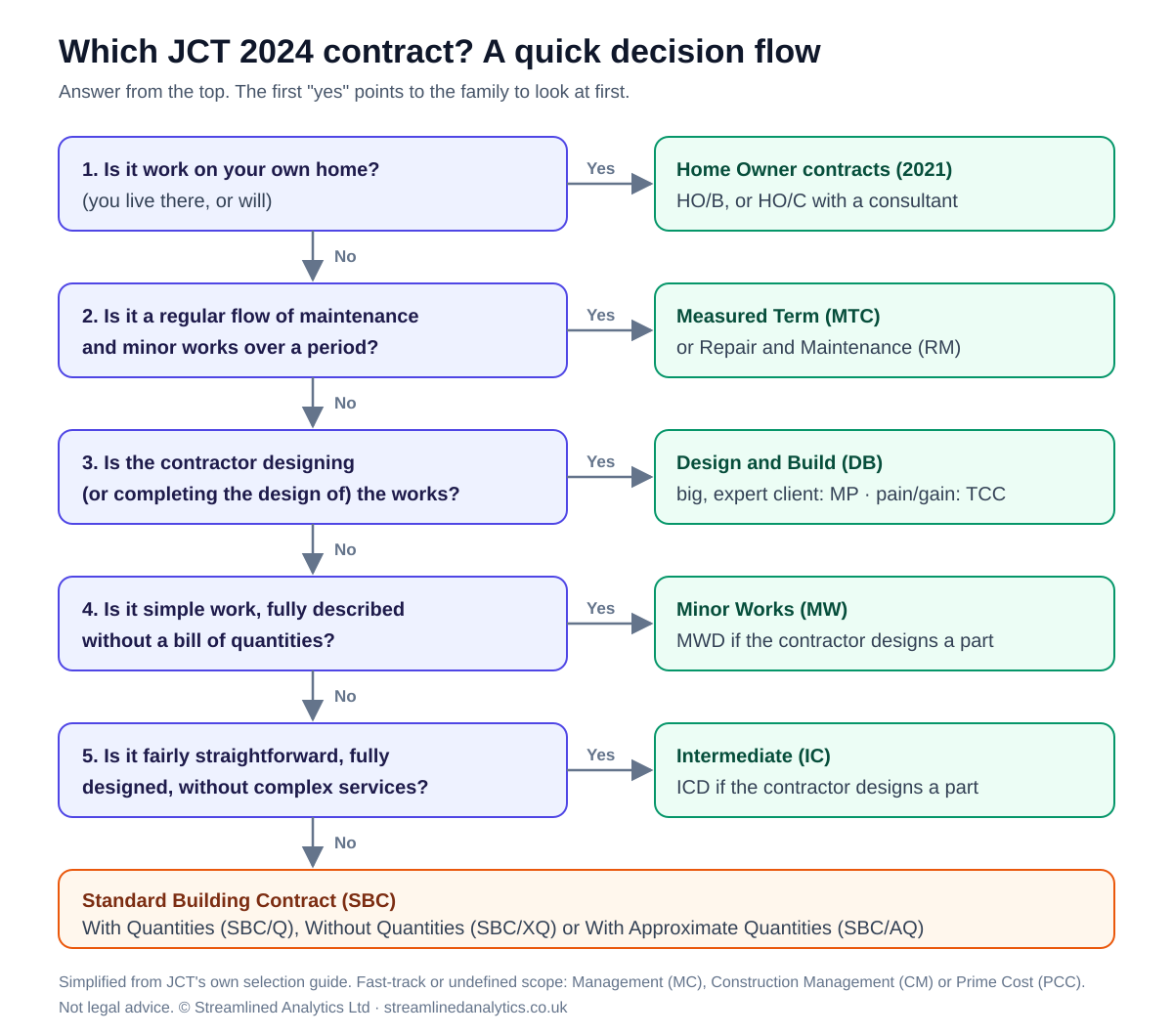
JCT's own guide to selecting the appropriate JCT main contract 2024 works through a chain of questions, and its Contract Finder does the same online. Simplified, the questions run in this order:
- Is it work on your own home? Then it's a Home Owner contract, not a commercial form.
- Is it a regular flow of maintenance and minor works over a period? Look at the Measured Term Contract or the Repair and Maintenance Contract.
- Who designs? If the contractor designs, or completes the design, it's Design and Build, or Major Project for a large job with an experienced client, or Target Cost if the client wants a pain/gain share.
- Is the design complete, and do you need a bill of quantities? No bill and simple work points to Minor Works; a bill points to the Standard Building Contract.
- Is it simple, or complex? Complex work, lots of building services, or a need for named sub-contractors and detailed procedures pushes you from Minor Works to Intermediate, and from Intermediate to the Standard Building Contract.
The "with contractor's design" versions (MWD, ICD and SBC with a contractor's designed portion) are for jobs that are otherwise traditional but where the contractor designs a defined part, such as the mechanical services or a curtain wall.
If you're the subcontractor: which JCT sub-contract goes with which main contract?#
Every JCT main contract has its own sub-contracts, written to sit underneath it. JCT's sub-contract selection guide asks two questions: will the sub-contractor design, and is the package small and simple enough not to need detailed procedures?
| Main contract | Sub designs part of the package | Sub doesn't design | Small, simple package |
|---|---|---|---|
| Standard Building Contract (SBC) | SBCSub/D/A + SBCSub/D/C | SBCSub/A + SBCSub/C | ShortSub |
| Design and Build (DB) | DBSub/A + DBSub/C | DBSub/A + DBSub/C | ShortSub |
| Intermediate (IC / ICD) | ICSub/D (ICD only) | ICSub/A + ICSub/C | ShortSub |
| Intermediate, named sub-contractor | ICSub/NAM | ICSub/NAM | |
| Minor Works (MW / MWD) | MWSub/D (MWD only) | ShortSub | ShortSub |
| Target Cost (TCC) | TCCSub/A + TCCSub/C | TCCSub, or ShortSub if no sub-contract target | ShortSub |
| Major Project (MP) | MPSub | MPSub | |
| Home Owner (HO/B, HO/C) | ShortSub | ShortSub | |
| Work you sub-let yourself | SubSub | SubSub | SubSub |
What "back-to-back" means for your dates. The full sub-contracts (SBCSub, DBSub, ICSub) are designed to mirror the main contract, and they can share the main contract's interim valuation date so that, in JCT's words about its 2016 Design and Build forms, the main contractor, sub-contractor and sub-subcontractors are all paid within a 30-day period from that date. So your payment dates hang off a date set in a contract you probably haven't seen. Ask for the main contract's interim valuation date and payment periods at tender.
The Short Form of Sub-Contract (ShortSub) is different. JCT says it isn't suitable where the sub designs anything or where fully back-to-back terms are needed, and it has no Sub-Contract Particulars section, so the dates and percentages have to be written down somewhere else. Make sure they are.
Match the edition. JCT says that where a 2016 main contract is used, the matching 2016 sub-contracts need to be used too. A 2024 sub-contract under a 2016 main contract will not line up.
The bespoke-or-amended reality. Many tier-one contractors use their own sub-contract, or a JCT with pages of amendments. Either way, these are the things to find in the first ten minutes:
- Payment days: due date, final date and notice periods. Compare them with the main contract's and with the Act.
- Set-off and contra charges: how wide the right is, and whether a pay less notice is still required.
- Pay-when-paid: making your payment depend on the main contractor being paid is ineffective unless the payer up the chain is insolvent.
- Notice conditions: any clause that says you lose time or money if a delay or variation notice is late.
- Retention: the percentage and what triggers each release, especially whether release waits for the whole project.
- Liquidated damages and liability caps: the daily or weekly rate, and whether your liability is capped at all.
- Adjudication: who nominates the adjudicator, and anything that tries to make it harder or costlier to use.
What a JCT contract means for your money#
Once you've signed one, a JCT contract decides four things about your cash: when each payment is due, how changes get paid, how much is held back and when it comes back, and what you can claim when the job runs late. Law firms tend to write about these from the client's side. Here they are from the side that's waiting to be paid.
Your money
When you get paid: the JCT payment cycle#
The cycle JCT describes for its main contracts runs like this:
- Interim Valuation Date (IVD): set in the contract particulars, usually monthly. JCT recommends the first is no more than a month after possession.
- Due date: 7 days after the IVD.
- Payment notice: within 5 days of the due date, saying what's due and how it's worked out.
- Pay less notice: no later than 5 days before the final date for payment, if the payer means to pay less than the notified sum.
- Final date for payment: 14 days after the due date.
This is the pattern JCT sets out in its own explainers on the 2016 Standard Building and Design and Build contracts. Treat it as the starting point and check the 2024 form you're on: your contract particulars and any amendments govern.
- No payment notice? Your application, made on time, stands as the payment notice, and the sum in it becomes payable unless a valid pay less notice arrives in time.
- Design and Build is application-led. Under DB, if there's no application no payment becomes due, and if the application arrives after the IVD, the due date moves to 7 days after it's received. Under SBC, the contract administrator certifies whether you apply or not.
- Sub-contracts: don't assume the main contract's days. Check your sub-contract particulars. JCT's aim is that everyone down the chain is paid within about 30 days of the common IVD.
- Late payment interest: JCT's explainer on SBC 2016 gives 5% over the Bank of England base rate. Check the figure in your own form.
- CIS: if you're a subcontractor in the Construction Industry Scheme, what lands in the bank is net of your CIS deduction, which is taken from the labour element.
Worked example. Hallam Build Ltd (fictional) is main contractor on a JCT Design and Build 2024 job, with monthly IVDs. Northgate Interiors Ltd (fictional) does the drylining under a DBSub. Hallam's application reaches the client by the IVD of Thursday 28 January 2027. Counting calendar days, with day 1 the day after the starting date:
| Step | Rule | Date |
|---|---|---|
| Interim Valuation Date | Set in the particulars | Thu 28 Jan 2027 |
| Due date | IVD + 7 days | Thu 4 Feb 2027 |
| Payment notice deadline | Due date + 5 days | Tue 9 Feb 2027 |
| Pay less notice deadline | Final date − 5 days | Sat 13 Feb 2027 |
| Final date for payment | Due date + 14 days | Thu 18 Feb 2027 |
Notice the pay less deadline lands on a Saturday. Nothing in the pattern moves it to a weekday, so a careful payer serves by the Friday, and a careful payee treats Saturday as the cut-off: if no valid pay less notice has arrived by then, the notified sum is due in full by the final date. Northgate's own due and final dates hang off the same 28 January IVD but come from its DBSub particulars, so they'll be later than Hallam's.
Across Easter. Take an IVD of Thursday 25 March 2027. Straight calendar counting gives a due date of Thursday 1 April, a payment notice by Tuesday 6 April and a final date of Thursday 15 April. If your contract leaves public holidays out of its day counts, as the Construction Act does for Christmas Day, Good Friday and bank holidays, then Good Friday (26 March) and Easter Monday (29 March) drop out: the due date moves to Saturday 3 April, the payment notice deadline to Thursday 8 April and the final date to Saturday 17 April. Two days' difference is the gap between a valid notice and a late one, so find your contract's reckoning-of-periods clause and diary dates from that.
For the payer's side of this, see how to serve a valid pay less notice. Our free construction payment pack has the application, payment notice, pay less notice and suspension letters, with a deadline calculator.
Your money
Variations: how changes get paid (or don't)#
A change is only valued if it was instructed. On the traditional forms (Minor Works, Intermediate, Standard Building) the Architect or Contract Administrator issues instructions and changes are called Variations. On Design and Build they're called Changes, instructed by the Employer, usually through the Employer's Agent. If you're a sub, your instructions come from the main contractor, often by word of mouth on site.
Confirm verbal instructions in writing the same day. A written confirmation of verbal instruction (CVI) takes two minutes. An unrecorded instruction is where subcontractor margin leaks away: the work gets done, nobody can later prove it was asked for, and the value ends up as a contra-argument at final account.
How changes are valued. The larger forms (SBC, IC, ICD, DB, TCC) have detailed valuation rules. In broad terms, work like something already priced is valued at those rates, adjusted if the conditions are different; other work at fair rates; and work that can't be measured on daywork. Minor Works has no detailed rules, which leaves more to argue about. Major Project, Design and Build, Target Cost and the Standard Building Contract also let the client ask for a quotation before the change is instructed, so the price is agreed up front; JCT's 2024 comparison table shows Intermediate and Minor Works don't have that option.
Worked example. On Tuesday 9 February 2027, Hallam's site manager asks Northgate's supervisor to add a bulkhead over the reception desk. Northgate emails a CVI that afternoon and sends a quotation for £3,650 on Friday 12 February. Hallam agrees £3,400 in the March valuation, and it's certified the month after.
| Date | Event | Register status | Value |
|---|---|---|---|
| Tue 9 Feb | Verbal instruction on site; CVI emailed same day | Instructed | — |
| Fri 12 Feb | Quotation sent | Submitted | £3,650 claimed |
| March valuation | Value agreed with Hallam | Agreed | £3,400 |
| April valuation | Included in the certified sum | Certified | £3,400 |
Without the CVI, the same bulkhead sits in Northgate's books as "unagreed" for months, and in the cost value reconciliation it's either left out (understating the job) or counted at full value (overstating it). That is why the Instructed → Submitted → Agreed → Certified ladder matters: it's the same ladder a monthly cost value reconciliation (CVR) uses to decide how much of the variation value to count. Our free CVR template uses it, and you can log it in the toolkit's variation register from the day the instruction is given.
Your money
Retention: what's held and when it comes back#
Retention is a percentage of each interim payment held back until the work is complete and defects are put right. JCT provides for retention on every main form except Major Project. The percentage is whatever your contract particulars say, so don't rely on a figure you've heard: Minor Works, for example, sets it as the percentage of value certified before practical completion and the percentage after it.
- Release: typically part comes back at practical completion and the rest when the rectification period ends and making good is done. Your particulars set the exact proportions and periods.
- Trust: in the larger forms (SBC, IC, ICD, DB, TCC) the client holds retention as trustee, which gives some protection if the client goes under. Minor Works has no such provision.
- Retention bond: SBC, DB and TCC let the parties use a bond instead of cash retention. It's worth asking.
- Sub-contracts: check whether your release is tied to the main contract's practical completion and rectification period or to your own package. For an early trade, the difference can be well over a year.
Diary both release dates the day you sign, and chase in writing when each one arrives. Retention that nobody asks for tends to stay where it is.
Your money
Delays: extensions of time and loss and expense#
JCT separates time from money. Relevant Events are the causes of delay that can earn you an extension of time, which protects you from liquidated damages. Relevant Matters are the causes that can also earn you loss and expense: the money. Plenty of events give time but no money, such as exceptionally adverse weather.
- Notice: the larger forms ask you to notify a delay when it becomes reasonably apparent that progress is being or is likely to be delayed, with the cause and the expected effect. Late notice weakens your claim, and an amended sub-contract may make notice a condition of getting anything at all.
- Liquidated damages: the rate in the particulars is what you pay per day or week of unexcused delay. It's why an extension of time matters even when you can't claim money.
- Minor Works is lighter: it gives an extension for delay beyond the contractor's control and has no express loss and expense provision.
- What JCT 2024 added: law-firm summaries of DB 2024 report new and wider Relevant Events, including epidemics, changes in law and the exercise of statutory powers, and the discovery of things such as contaminated material or unexploded ordnance. Some only count as Relevant Matters if they're selected in the particulars, and not all were carried into Minor Works.
The practical rule is the same on every form: notify early, keep notifying, and log the date each delay became apparent, the notice you sent and the extension you got.
Your money
Final account#
After practical completion comes the final account: you send your documents, the final sum is worked out, and a final certificate or statement follows. The periods are long and differ by form, and missing one can leave the other side's figure standing. Diary every date in the particulars at the start, not when the job ends.
JCT 2024 vs JCT 2016: what's changed and what happens to 2016 jobs#
The dates. JCT 2024 launched with the Design and Build family on 17 April 2024, and the rest of the suite followed. JCT 2016 was withdrawn on 31 March 2026, with a transition period to 31 December 2026. After that, 2016 contracts can't be bought in any format. The Home Owner contracts stay on their 2021 edition. (Source: JCT, withdrawal of the JCT 2016 edition.)
What it means for you:
- Contracts already signed on 2016 terms generally stay on them. The transition exists so projects already started or tendered on 2016 can be finished. If you're unsure about a particular job, take advice.
- Expect 2024 forms in new enquiries. From January 2027 nobody can buy a new 2016 form.
- Keep the chain on one edition. A 2016 main contract needs 2016 sub-contracts below it (JCT).
The main changes in plain words. From JCT's own documents and law-firm summaries of the new forms:
- Collaborative working is now in the core of each contract rather than an optional extra, alongside sustainability provisions.
- Notices by email are allowed to addresses given in the particulars. Law-firm summaries report exceptions or opt-ins for termination and default notices.
- A payment timetable after termination (clause 8.13 in DB 2024), so there are dates for what's owed when a contract ends early.
- More Relevant Events and Relevant Matters (see Delays above).
- Fluctuations options A, B and C are published as separate free documents, and you choose one (or none) in the particulars.
- A new Target Cost family, with its own sub-contract.
- Building Safety Act 2022 references. JCT publishes a note on how the 2024 forms deal with it.
JCT also sells tracked-change versions of the main 2024 forms against 2016 if you need to see every edit.
JCT vs NEC: the short version#
NEC is the other big family of UK standard forms, published by the Institution of Civil Engineers. The difference is mostly one of style, and it changes how you get paid and claim.
| JCT | NEC | |
|---|---|---|
| Style | Traditional legal drafting; sets out rights and obligations | Plain English, present tense; a project-management tool as much as a contract |
| Where it's used | Mostly building work, private and public | Common on infrastructure and public-sector work |
| How payment is worked out | Valuation and certificate by the Contract Administrator (or application-led in DB) | The Project Manager assesses the amount due |
| Changes | Variations (or Changes in DB), valued under the valuation rules | Compensation events, priced on their effect on time and cost |
| Time bars | Notice rules, but fewer hard cut-offs in the standard form | Strict deadlines to notify compensation events, with a time bar |
If you're moving between the two, the habit that transfers is the same: notify promptly and keep a register. NEC's own site is neccontract.com.
JCT contracts in Scotland and Northern Ireland#
Scotland uses versions of the JCT forms published by the Scottish Building Contract Committee (SBCC), itself a JCT member. SBCC used to publish Scottish supplements to sit beside JCT forms; it now publishes integrated versions amended for Scots law, such as the Design and Build Contract for use in Scotland. The payment fallback is the Scheme for Construction Contracts (Scotland) Regulations 1998.
Northern Ireland uses JCT forms with adaptation schedules published by the Royal Society of Ulster Architects, and its payment law is the Construction Contracts (Northern Ireland) Order 1997.
The payment rules are close to England and Wales but not identical. For which law applies where, see our guide to the Construction Contracts Act.
How much does a JCT contract cost, and can I get a free JCT template?#
Prices from JCT's 2026 price list, excluding VAT:
- Minor Works Building Contract (MW 2024): £50 printed, £100 On Demand.
- Design and Build Contract (DB 2024): £102 printed, £204 On Demand.
- Design and Build or Standard Building Sub-Contract: the Agreement is £81 and the Conditions £94 printed, or £256 each On Demand.
- Short Form of Sub-Contract (ShortSub 2024): £35 printed, £70 On Demand.
- The complete 2024 edition (all six volumes): £1,509.
Can you get a JCT contract template free? No. JCT forms are copyright, and the "free JCT contract PDF" copies on document-sharing sites are unlicensed and often out of date (2011 or 2016 editions). Signing up to an old edition, or an unofficial copy someone has edited, is a real risk: you may be agreeing to terms nobody has read properly.
What you can use for free:
- JCT's Contract Finder, its selection guides and the practice note Deciding on the appropriate JCT contract 2024.
- JCT's user checklists for Minor Works, on its useful documents page, which list every particular you need to fill in.
- Our JCT Contract Toolkit. It doesn't replace the contract. It's what you run the contract with: the summary, the dates and the registers.
Running JCT jobs without missing a date#
One JCT job has a handful of dates a month: an IVD, a due date, two notice windows and a final date, plus retention releases and delay notices. Ten jobs on different forms and amendments is dozens of deadlines, usually kept in someone's diary or a spreadsheet only they understand. That is where payment notices go unchallenged, instructions go unrecorded and retention goes unchased.
If the spreadsheet is starting to creak, we build software for construction contractors that puts every job's valuation dates, notices and variations in one place, with reminders before each deadline.
FAQs
What does JCT stand for?
JCT stands for the Joint Contracts Tribunal, the body that publishes the JCT standard forms of building contract. It has produced standard forms since 1931 and has been a limited company since 1998. Its members include Build UK, the RIBA, the RICS, the Local Government Association, Real Estate:UK, the Contractors Legal Group and the Scottish Building Contract Committee.
What is a JCT contract in construction?
A standard-form contract published by the Joint Contracts Tribunal for building work in the UK. It sets out who designs, how and when the contractor is paid, how changes and delays are handled and what happens if things go wrong. The project-specific terms, such as valuation dates, retention and damages, go in the contract particulars.
What types of JCT contract are there?
The main 2024 families are Minor Works (MW, MWD), Intermediate (IC, ICD), the Standard Building Contract (SBC/Q, SBC/XQ, SBC/AQ), Design and Build (DB), Major Project (MP), Target Cost (TCC) and the management forms (MC, CM, PCC). There are also maintenance contracts (MTC, RM), Home Owner contracts (2021) and framework and partnering forms, each with matching sub-contracts.
Which JCT contract should I use?
It depends on who designs, how complete the design is and how complex the job is. Contractor design points to Design and Build; simple, fully designed work to Minor Works; fairly straightforward work to Intermediate; and larger or complex work with a bill of quantities to the Standard Building Contract. For work on your own home, use a Home Owner contract. JCT's Contract Finder walks you through it.
What is the latest JCT design and build contract?
The JCT Design and Build Contract 2024 (DB 2024), published on 17 April 2024 with its sub-contracts DBSub/A and DBSub/C 2024. It was the first family of the 2024 edition. The 2016 version was withdrawn on 31 March 2026.
What are the changes between JCT 2016 and 2024?
Collaborative working and sustainability move into the core of each contract, notices can be sent by email, there is a payment timetable after termination, there are more Relevant Events and Relevant Matters (such as epidemics and changes in law), the fluctuations options are separate documents and there is a new Target Cost family. Check the form itself for the detail.
Can I still use a JCT 2016 contract?
JCT withdrew the 2016 edition on 31 March 2026 and sells it only during a transition period ending on 31 December 2026, after which it can't be bought in any format. Contracts already signed on 2016 terms generally carry on, and a 2016 main contract needs 2016 sub-contracts. For a particular job, take advice.
What are the payment terms in a JCT contract?
On the pattern JCT describes for its main contracts, payment is due 7 days after each interim valuation date, the payment notice follows within 5 days of the due date, any pay less notice must be given no later than 5 days before the final date, and the final date is 14 days after the due date. Your particulars, amendments and sub-contract terms can change all of these.
What's the difference between JCT and NEC contracts?
JCT uses traditional legal drafting and is mostly used on building work, with changes handled as variations valued by a contract administrator. NEC is written in plain English as a project-management tool, is common on infrastructure and public work, and handles changes as compensation events with strict notification time bars.
How much does a JCT contract cost?
On JCT's 2026 price list, excluding VAT, Minor Works 2024 costs £50 in print and the Design and Build Contract 2024 £102. A Design and Build or Standard Building sub-contract is £81 for the Agreement plus £94 for the Conditions in print, and the Short Form of Sub-Contract is £35. On Demand online versions cost more.
Can I download a JCT contract template for free?
No. JCT contracts are copyright and sold by JCT, and free PDF copies online are unlicensed and often an old edition. What you can get free is JCT's guidance and Contract Finder, and our JCT Contract Toolkit, which helps you run a JCT job: contract summary, payment calendar and variation register.
Is a JCT contract legally binding, and do I need one for a small job?
Yes, once the parties have agreed and signed it, it's a binding contract. For small jobs JCT offers Minor Works, the Short Form of Sub-Contract and, for homeowners, the Home Owner contracts. Any written contract that sets out the price, scope, payment dates and how changes are handled is better than none. This is general information, not legal advice.
Do JCT contracts apply in Scotland?
Scotland uses versions of the JCT forms published by the Scottish Building Contract Committee, amended for Scots law, such as the Design and Build Contract for use in Scotland. The payment fallback is the Scheme for Construction Contracts (Scotland) Regulations 1998.
Sources: JCT, withdrawal of the JCT 2016 edition; JCT 2024 Edition, available contracts; JCT Explains: Interim Payments; JCT Design and Build Contract 2016: Simply Fair; JCT practice note, Deciding on the appropriate JCT contract 2024; JCT sub-contract selection guide 2024; JCT useful documents and 2026 price list; JCT, about us; Scheme for Construction Contracts (Scotland) Regulations 1998; Construction Contracts (Northern Ireland) Order 1997.
Updated November 2026. This article is general information for England and Wales about the JCT standard forms as at November 2026. It is not legal advice, and it doesn't reproduce or replace any JCT contract. Check your own contract, its particulars and its schedule of amendments, and speak to a construction solicitor or adviser before relying on it.
Keep reading
Construction Contracts Act: a practical guide to getting paid under the Construction Act (UK)
What people call the Construction Contracts Act, which contracts it covers, the payment dates and notices worked through on a real job, what the Scheme fills in, and what to do when you're not paid. With a free payment pack.
13 October 2026 ReadPay less notice: the deadline, what it must say, and a free template (UK construction)
A pay less notice lets the paying side pay less than the notified sum, but only if it says how much and why, and arrives in time. The deadlines, how Christmas and bank holidays move them, a worked example and a free template.
13 October 2026 ReadWhat is cost value reconciliation (CVR)? A guide for UK contractors
Cost value reconciliation (CVR) compares what a construction job has cost with the value of the work done, to show the margin you are really making and where it is heading. How it works, step by step, with a worked example.
6 October 2026 Read