
To calculate a CIS deduction, take the payment excluding VAT, subtract what the subcontractor actually paid for materials, consumables, fuel (not fuel for travel) and plant hired from someone else, then multiply what is left by the CIS rate: 20% if registered, 30% if not, 0% with gross payment status. Labour, travel and subsistence, and any mark-up on materials all stay in the amount CIS is taken from.
The CIS deduction formula#
HMRC's guide, CIS 340, sets out two steps (paragraph 3.12):
- Start with the gross payment, excluding VAT if the subcontractor is VAT-registered.
- Take off what the subcontractor actually paid for materials, consumable stores, fuel (except fuel for travel), plant hire, and the cost of manufacturing or prefabricating materials.
Multiply what is left by the rate HMRC gave when the contractor verified the subcontractor. That is the deduction. The contractor pays the subcontractor the rest and passes the deduction to HMRC.
The deduction is an advance payment towards the subcontractor's own tax and National Insurance, not an extra tax. A limited company gets it back by offsetting it against its PAYE bill; a sole trader claims it through Self Assessment (CIS 340, 1.10 to 1.11).
=(Net_invoice - Materials_cost - Hired_plant_cost) * CIS_rateWhich CIS rate: 20%, 30% or 0%?#
The rate is not the subcontractor's choice or the contractor's. It comes from HMRC when the contractor verifies the subcontractor before paying them for the first time.
- 20%: the subcontractor is registered for CIS.
- 30%: the subcontractor is not registered, or HMRC cannot match them. The contractor gets a verification number, which must go on the subcontractor's statement.
- 0%: the subcontractor has gross payment status. Nothing is deducted, but the payment still goes on the monthly return.
Using the worked example below, the same £9,000 subject to CIS gives £1,800 at 20%, £2,700 at 30% and nothing at gross status. A contractor does not need to verify again if the subcontractor was on one of its returns in the current or the two previous tax years (CIS 340, 3.2).
What counts as materials for CIS?#
This is where most CIS calculations go wrong, so it is worth being precise. The amount that comes off is the subcontractor's direct cost:
- Materials and consumables at what the subcontractor paid. If you buy board for £2,800 and charge £3,150, only £2,800 comes off. The £350 mark-up is part of your profit, and CIS is taken from it. If you are unsure how your mark-up and margin relate, our guide to markup vs margin for contractors has the formulas.
- Plant hired from someone else, and the fuel for it (CIS 340, 3.14).
- Not your own plant. There is no notional hire charge for a machine you own, though the fuel you buy for it can come off.
- Including VAT if you are not VAT-registered, because the VAT you paid is then part of your cost.
- Only materials you paid for yourself. If the contractor supplied them, or paid you back for them, they do not count.
The contractor has to be satisfied the materials figure is reasonable. If you will not tell them your cost, or it looks too high, HMRC's guidance lets the contractor estimate it (CISR15060). It is usually simpler to show the cost on the invoice or send it on request.
Are travel and subsistence subject to CIS?#
Yes. CIS 340 is explicit that the deduction applies to any part of a payment for travelling expenses or subsistence, including fuel for travel (paragraphs 2.17 and 3.11). Putting travel in the materials column is a common way to under-deduct.
Fuel is the trap. Diesel for a generator or a hired digger on site is a cost that comes off. Diesel for the van to get the team there is travel, and CIS is taken from it.
A worked CIS calculation#
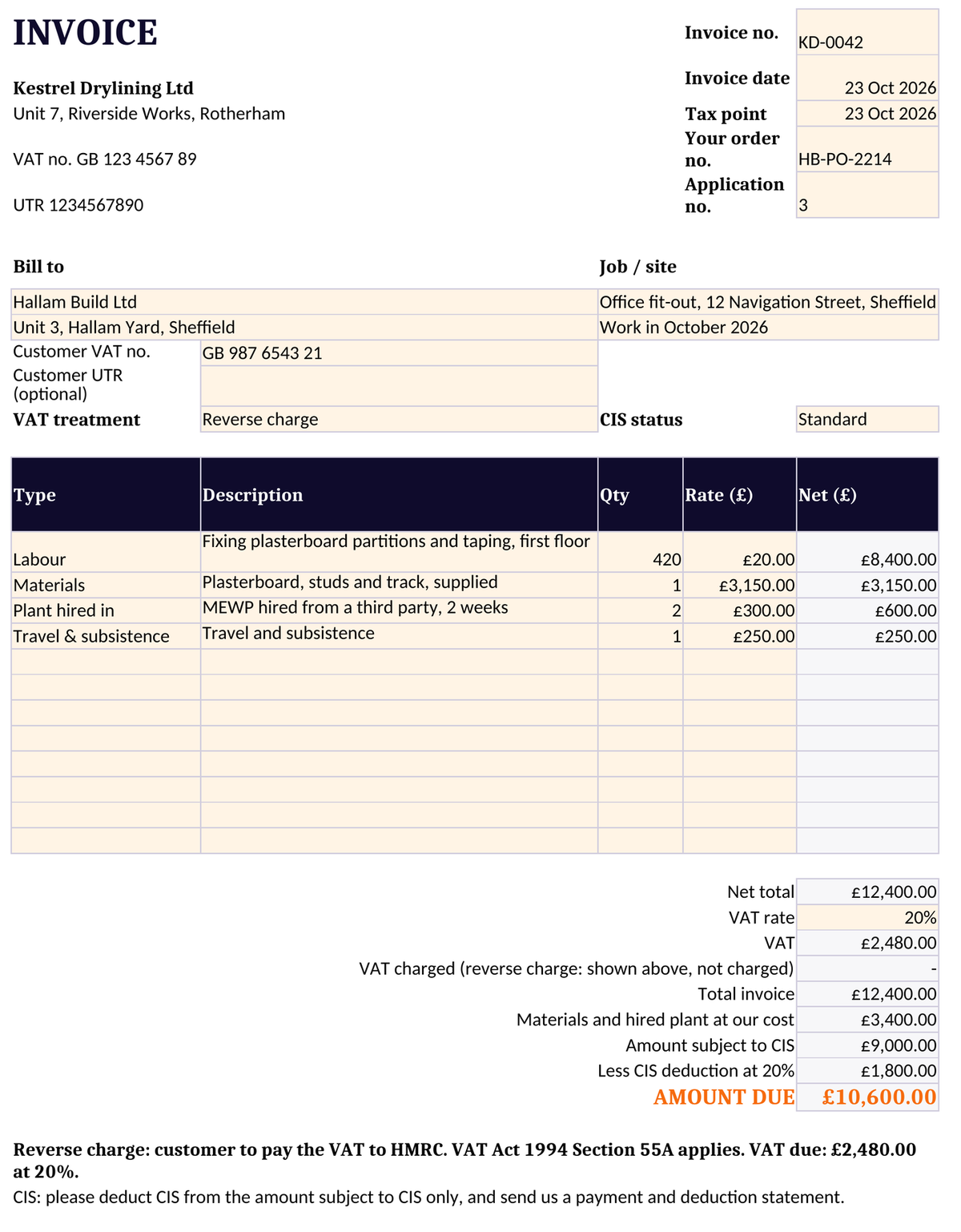
Kestrel Drylining Ltd is VAT- and CIS-registered at 20%. It invoices Hallam Build Ltd, also VAT- and CIS-registered and not an end user, for October's work on an office fit-out. Both companies are fictional; the figures are the ones in our free pack.
| Invoice line | Charged (net) | Comes off before CIS |
|---|---|---|
| Labour: 420 hours at £20 | £8,400.00 | £0.00 |
| Materials: board, studs and track (cost £2,800) | £3,150.00 | £2,800.00 |
| MEWP hired from a third party | £600.00 | £600.00 |
| Travel and subsistence | £250.00 | £0.00 |
| Net invoice | £12,400.00 | £3,400.00 |
| Amount subject to CIS (£12,400 − £3,400) | £9,000.00 | |
| CIS deduction at 20% | £1,800.00 | |
| VAT at 20% (reverse charge: shown, not charged) | £2,480.00 | |
| Amount due (£12,400 − £1,800) | £10,600.00 |
Two things to notice. The materials come off at £2,800, the price Kestrel paid, not the £3,150 it charged. And the VAT is £2,480, 20% of the full £12,400, but because the reverse charge applies it is shown on the invoice and not added to the amount due. Our guide to the domestic reverse charge explains when that applies and what the invoice has to say.
Is CIS calculated before or after VAT?#
Before. CIS is worked out on the payment excluding VAT, and VAT is worked out on the full net invoice, never on the figure after CIS.
Where the reverse charge applies, there is no VAT in the payment at all: the customer pays it to HMRC through its own VAT return. Where normal VAT applies (for example, the customer has told you in writing it is an end user), the customer pays you the VAT, and the CIS deduction stays exactly the same. In the example, the amount due would be £12,400 + £2,480 − £1,800 = £13,080.
Accounting software trips people up here. If CIS is entered as a negative line on the invoice, some packages work out VAT on the total after CIS. Keep CIS off the VAT calculation entirely.
The five common CIS calculation mistakes#
| Mistake | CIS deducted | What goes wrong |
|---|---|---|
| None: the right method | £1,800.00 | £9,000 × 20% |
| Materials taken at the price charged (£3,150), not the cost (£2,800) | £1,730.00 | £70 too little deducted; the mark-up has escaped CIS |
| CIS on the whole net invoice | £2,480.00 | £680 too much taken from the subcontractor |
| CIS on the net invoice plus VAT | £2,976.00 | £1,176 too much; VAT is never subject to CIS |
| The MEWP was the sub's own but claimed as hired plant | £1,800.00 | Should be £1,920.00: own plant gets no deduction |
| VAT charged normally instead of reverse charged | £1,800.00 | CIS is right, but the invoice asks for £13,080.00 instead of £10,600.00 |
The under-deductions matter to the contractor, not just the subcontractor: deductions that should have been made are still payable to HMRC even if they were not taken (CIS 340, 4.12). The over-deductions leave the subcontractor short of cash until they claim the money back.
How to work out gross from net under CIS#
Sometimes you know what landed in the bank and need the invoice figure. For labour only, divide by what is left after the deduction: at 20%, gross = net ÷ 0.8, so £8,000 received means £10,000 invoiced.
With materials, the materials are not reduced, so the sum is: gross = (net received − CIS rate × materials cost) ÷ (1 − CIS rate). In the worked example, (£10,600 − 20% × £3,400) ÷ 0.8 = £12,400.
Set-offs, contra charges and retentions#
Three adjustments change the figure CIS is taken from, or the timing:
- A set-off, where the contractor withholds money for a breach or defective work, reduces the gross amount CIS is calculated on (CIS 340, 6.11).
- A contra charge, where the contractor charges the subcontractor for goods or services such as skip hire or welfare, does not. CIS is worked out as if it had not been made.
- A retention has no special rules. CIS is applied when the retention is actually paid, at the subcontractor's status on that date (CIS 340, 6.13).
Online CIS calculators vs a spreadsheet#
A quick online CIS calculator is fine for a labour-only invoice. Most ask for two numbers, labour and materials, and do the multiplication. Several of the free calculators we checked do not ask whether the materials figure is your cost or your price, whether the plant is hired or your own, or where travel goes, and a few give guidance on plant hire and fuel that does not match CIS 340.
A spreadsheet that types each invoice line handles those cases, keeps a record, and on the contractor side feeds the monthly payment and deduction statement. That is what we built into the free CIS invoicing pack.
If your invoices are rebuilt by hand each month from quotes, job sheets and timesheets, and then keyed into your accounts again, the arithmetic is the easy part; the retyping is where the time goes. That is the work we build software to take out. Book a short call and we will look at it on your own jobs.
This article is general information based on HMRC guidance as at October 2026. It is not legal, tax or financial advice. Check the rules on GOV.UK or speak to an accountant or adviser before relying on it.
FAQs
How do I calculate CIS deductions?
Take the payment excluding VAT, subtract the subcontractor's direct cost of materials, consumables, non-travel fuel and plant hired from a third party, then multiply by 20%, 30% or 0%. On a £12,400 invoice with £3,400 of materials and hired plant at cost, the deduction at 20% is £1,800.
Is CIS 20% of the whole invoice?
No. It is 20% of the invoice excluding VAT, less the direct cost of materials and hired plant. Taking 20% of the whole invoice over-deducts whenever there are materials on it.
Do you pay CIS on materials?
Not on what the materials cost you, but you do on your mark-up. Plant hired from someone else counts as materials; your own plant does not.
Is CIS deducted before or after VAT?
CIS is calculated on the amount excluding VAT. VAT is calculated on the full net invoice and is never reduced by CIS.
Is CIS deducted from travel expenses?
Yes. Travel and subsistence, including fuel for travel, are subject to CIS.
How do I work out gross from net under CIS?
Gross = (net received − CIS rate × materials cost) ÷ (1 − CIS rate). For labour only at 20%, divide the net by 0.8.