
A pay less notice is the written notice a paying party serves when it intends to pay less than the notified sum: usually less than the subcontractor applied for. It must say the sum the payer now considers due and the basis on which that sum is calculated, and it must be given no later than the period your contract sets before the final date for payment, or 7 days before it if the contract sets none. If it is late, or not a valid notice, the notified sum has to be paid in full by the final date.
What is a pay less notice?#
The Construction Act (the Housing Grants, Construction and Regeneration Act 1996, as amended in 2011) sets up a chain of notices for every payment under a construction contract:
- Application for payment. The subcontractor says what it thinks is due and how it is worked out.
- Payment notice. Within 5 days of the due date, the payer (or someone named in the contract, such as the QS or contract administrator) says what it considers due and the basis (s.110A).
- Pay less notice. If the payer then wants to pay less than the notified sum, it must say so in a pay less notice, in time (s.111(3)).
- Payment of the notified sum, or the pay less figure, by the final date for payment (s.111(1)).
The notified sum is the figure in the payment notice. If no payment notice was given, it is usually the subcontractor's application, where the contract allows the application to be made before the payment notice deadline (s.110B(4)). So a pay less notice is the payer's last chance to reduce what it must pay this time round. It applies whoever the payer is: a client paying a main contractor, a main contractor paying a subcontractor, or a subcontractor paying its own sub-subs.
| Payment notice | Pay less notice | |
|---|---|---|
| Who gives it | The payer or a specified person | The payer or a specified person |
| When | No later than 5 days after the due date | No later than the agreed period before the final date (Scheme: 7 days) |
| Sum it states | The sum due at the due date | The sum due on the date the notice is served |
| Must give the basis? | Yes | Yes |
| Can it be zero? | Yes | Yes |
| If it is missing | The application usually becomes the notified sum | The notified sum is payable in full |
When must a pay less notice be served?#
The Act leaves the period to the contract. A pay less notice must be given "not later than the prescribed period before the final date for payment", which is the period the parties agreed or, if they agreed none, the Scheme for Construction Contracts' period (s.111(5) and (7)).
| Contract terms | Due date | Final date for payment | Pay less notice by |
|---|---|---|---|
| Scheme for Construction Contracts (contract silent) | Later of 7 days after the end of the period, or the claim | 17 days after the due date | 7 days before the final date |
| JCT 2016 main-contract pattern | 7 days after the valuation date | 14 days after the due date | 5 days before the final date |
| Your own contract | As written | As written | As written |
The Scheme figures are from paragraphs 4, 8 and 10 of Part II of the Scheme for Construction Contracts (England and Wales) Regulations 1998. The JCT figures are the pattern JCT describes for its 2016 main contracts; sub-contracts can differ, so check your sub-contract particulars before relying on 5 days.
Two more timing rules catch people out:
- Where the notified sum comes from the payee's own notice (its application or a default notice), a pay less notice can't be given before that notice (s.111(5)(b)). A pre-emptive pay less notice doesn't count.
- If the final date moves, the pay less deadline moves with it. Under the Scheme, a late application moves the due date, and the final date with it. If the contract's final date doesn't work, the Scheme's 17 days can replace it, and the payer's notices are then judged against that date.
How do you count the days?#
Section 116 of the Act sets two rules. A period "after or from" a date starts the day after it. And Christmas Day, Good Friday and bank holidays are left out of the count. Weekends are not: a deadline can fall on a Saturday.
What the Act doesn't say clearly is whether s.116 governs periods that the parties write into their own contract, or how to count backwards for "not later than 7 days before". So in our pack we count every deadline both ways, in plain calendar days and the s.116 way, and give a safe date: the earlier of the two for something you must do by a deadline, and the later for something you may only do after one. Most of the year the two agree. Around Christmas and Easter they don't.
A worked example: how Christmas moves the dates#
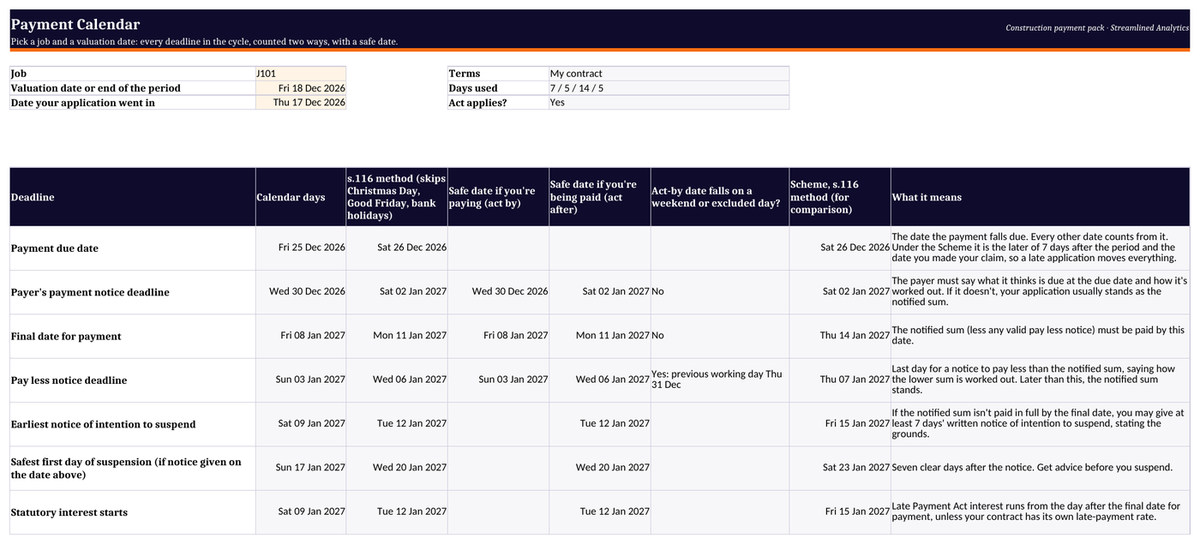
A fictional drylining subcontractor applies for £61,200 on job J101, with a valuation date of Fri 18 Dec 2026. Its sub-contract says: due 7 days after the valuation date, payment notice within 5 days of that, final date 14 days after the due date, and pay less notice at least 5 days before the final date. Christmas Day falls on a Friday and the Boxing Day bank holiday moves to Mon 28 Dec, so the counts drift.
| Deadline | Calendar days | Skipping Christmas Day and bank holidays (s.116) | Safe date |
|---|---|---|---|
| Due date | Fri 25 Dec | Sat 26 Dec | - |
| Payment notice by | Wed 30 Dec | Sat 2 Jan | Wed 30 Dec |
| Pay less notice by | Sun 3 Jan | Wed 6 Jan | Sun 3 Jan (Thu 31 Dec in practice) |
| Final date for payment | Fri 8 Jan | Mon 11 Jan | Late only after Mon 11 Jan |
No payment notice came. The main contractor served a pay less notice for £52,000 on Thu 7 Jan 2027, citing "cleaning and damage" with no breakdown. That is a day after even the later, s.116 deadline (Wed 6 Jan), so it is late by both counts, and it gives no basis either. The application stands as the notified sum, and the full £61,200 is due by Mon 11 Jan.
If the payer had used the Scheme's periods instead (17 days to the final date, 7 days for the pay less notice), the final date would be Mon 11 Jan by calendar days or Thu 14 Jan the s.116 way, and the pay less deadline Mon 4 Jan or Thu 7 Jan. That is why the pack shows the Scheme dates alongside your contract's.
What must a pay less notice say?#
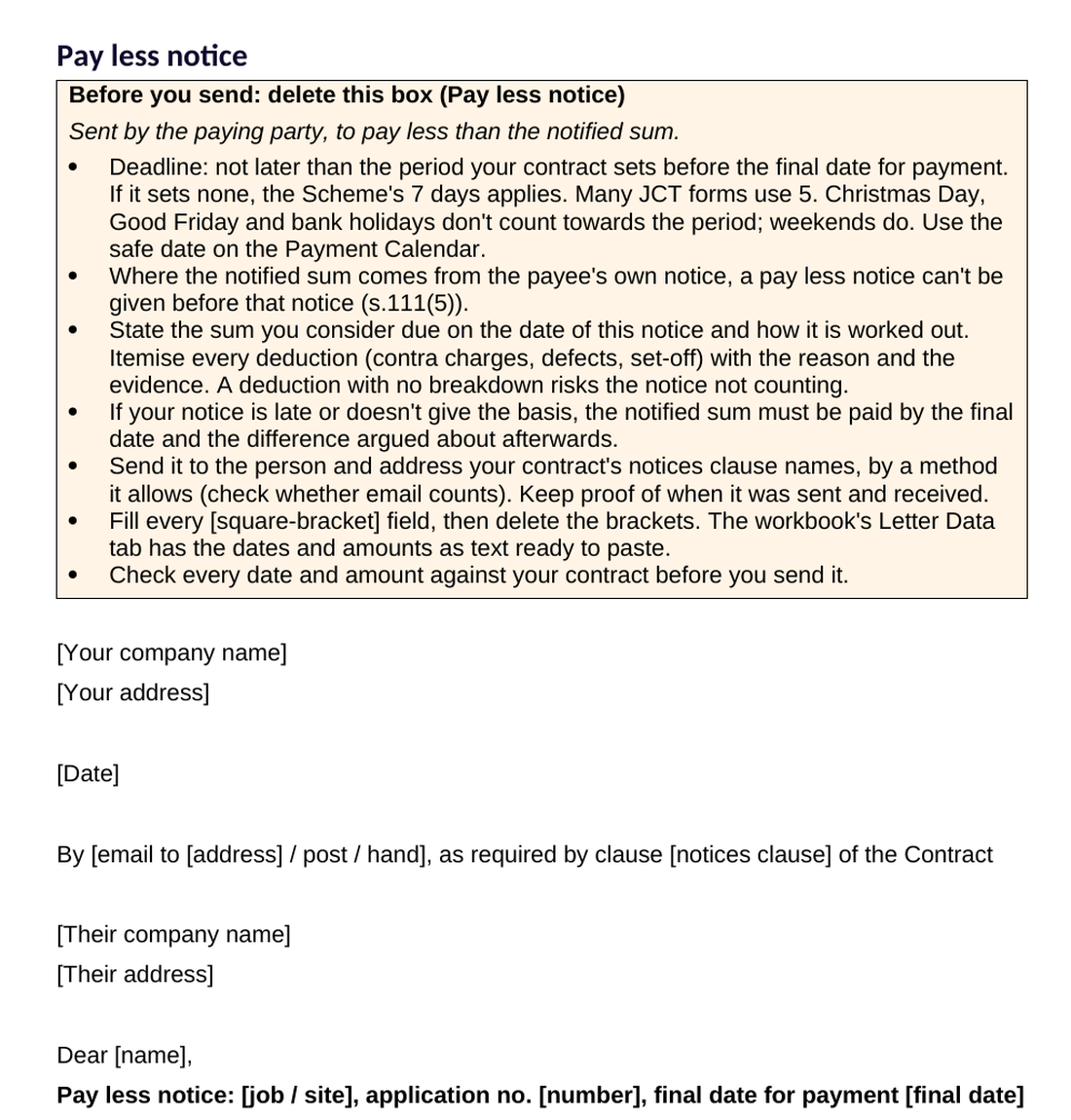
Section 111(4) asks for two things, and a sensible notice adds two more:
- The sum the payer considers due on the date the notice is served. Not the deduction: the figure it will pay. Zero is allowed.
- The basis on which that sum is calculated. Itemise each deduction: the valuation adjustments, each contra charge with what it is for, any set-off. A bare figure, or "contra: £9,200" with nothing behind it, invites a challenge.
- Which payment it relates to. The application or payment notice number and the notified sum it reduces.
- Served the way the contract says. Check the notices clause: who it goes to, at which address, and whether email counts.
Our Word template has a "before you send" box with these checks and the deadline, which you delete before sending, so nothing of ours ends up in the letter.
What happens if a pay less notice is late or invalid?#
The payer must pay the notified sum, to the extent not already paid, on or before the final date for payment (s.111(1)). A late notice, or one that doesn't state a sum and its basis, doesn't change that. The payer can still dispute what the work was really worth later, for example in adjudication, but the courts have said it generally has to pay the notified sum first. Pay now, argue later.
If the money still doesn't arrive by the final date, the subcontractor has four tools:
- Suspend work. After at least 7 days' written notice of intention to suspend, stating the grounds, it can suspend any or all of its obligations until paid in full. The payer must cover the reasonable costs of the suspension, and the time is added to the contract period (s.112). This is suspension, not walking off the job: get advice first.
- Charge statutory interest under the Late Payment of Commercial Debts (Interest) Act 1998, unless the contract sets its own substantial late-payment remedy.
- Adjudicate. Either party can refer a dispute to adjudication at any time; the adjudicator decides within 28 days of referral unless the time is extended (s.108).
- Send a letter before action. For construction debts this follows the Pre-Action Protocol for Construction and Engineering Disputes, not the generic debt letter most templates use. The protocol need not be followed before a summary judgment claim or a claim to enforce an adjudicator's decision.
In the example, nothing is paid by Mon 11 Jan. The notice of intention to suspend can go on Tue 12 Jan, and the safest first day of suspension is Wed 20 Jan, after 7 clear days counted both ways. Interest runs from Tue 12 Jan:
| Item | Figure |
|---|---|
| Debt (the notified sum) | £61,200.00 |
| Bank Rate on 31 Dec 2026 (the reference date for interest starting in January) | 3.75%, if unchanged |
| Statutory rate (Bank Rate + 8%) | 11.75% a year |
| Daily interest (£61,200 × 11.75% ÷ 365) | £19.70 |
| Interest for 30 days, to Wed 10 Feb 2027 | £591.04 |
| Fixed compensation (debt of £10,000 or more) | £100.00 |
| Total claimable after 30 days | £691.04 |
The rate is fixed by the Bank Rate on the 30 June or 31 December before interest starts, not today's rate (SI 2002/1675, art. 4). Bank Rate has been 3.75% since 18 December 2025; if it changes before 31 December 2026, so does this figure. The fixed sum is £40, £70 or £100 per debt depending on its size, and each interim payment is its own debt (s.5A). Reasonable recovery costs above the fixed sum can be claimed too.
Can they deduct contra charges without a pay less notice?#
Not from the notified sum. A contra charge (for cleaning, damage, another trade brought in) is a reason to pay less, so it needs a valid pay less notice, served in time, that shows how the deduction is worked out. Without one, the notified sum is payable by the final date, and the contra is argued about afterwards.
If you are under CIS, note that a set-off and a contra charge are treated differently: a set-off for defective work reduces the amount CIS is taken from, a contra charge for goods or services doesn't. Our guide to calculating a CIS deduction works through it, and the contractor's CIS payment and deduction statement should match what was actually paid.
Does the Construction Act apply to your job?#
Pay less notices only exist under the Act, and the Act doesn't cover every job:
- Homeowners. It doesn't apply to a contract with a residential occupier: work mainly on a house or flat that one of the parties lives in or means to live in (s.106). A householder can't serve a pay less notice under the Act, and a builder can't rely on one against them.
- Supply only. Making or delivering materials, plant or components to site isn't a construction operation unless the contract also covers installing them (s.105(2)(d)). Supply-and-fix is covered; supply-only isn't, though statutory interest can still apply.
- Where the work is. This article covers England and Wales. Scotland has its own Scheme and its own bank holidays, and Northern Ireland has separate legislation.
Keeping track of pay less deadlines across every job#
One notice is easy. Twelve live jobs, each with a monthly application, a payment notice that may or may not come, a pay less deadline and a final date, is where money slips. The applications tracker in the pack keeps every application on every job in one table: the notified sum, whether each notice from the other side arrived on time and gave a basis, what is payable, and what is overdue today.

The same three numbers, applied, assessed and paid, are what a monthly cost value reconciliation needs on the value side. Our free CVR template picks up from there.
If you are keying applications, notices and payments into a spreadsheet by hand from emails and your accounts, the deadlines are the easy part; the retyping is where the time goes. That is the work we build software to take out, with overdue money and notices due on a live dashboard instead. Book a short call and we will look at it on your own jobs, or start with the free construction payment pack.
This article is general information based on the Housing Grants, Construction and Regeneration Act 1996, the Scheme for Construction Contracts (England and Wales) Regulations 1998 and the Late Payment of Commercial Debts (Interest) Act 1998 as at October 2026. It is not legal, tax or financial advice. Check your contract and speak to a construction solicitor or adviser before relying on it, especially before you suspend work or start a claim.
FAQs
What is a pay less notice in construction?
A written notice from the payer saying it intends to pay less than the notified sum, stating the sum it now considers due and how that sum is calculated. It must be served by the deadline in the contract, or 7 days before the final date for payment under the Scheme.
What are the pay less notice timescales?
Whatever your contract says before the final date for payment. If it says nothing, the Scheme's 7 days before the final date applies, and the final date is 17 days after the due date. JCT 2016 main contracts use 5 days before a final date 14 days after the due date. Christmas Day, Good Friday and bank holidays don't count; weekends do.
Can you give an example of a pay less notice?
"Further to your application no. 6 dated 18 December 2026 for £61,200, we give notice under clause [x] and section 111 of the Housing Grants, Construction and Regeneration Act 1996 that we intend to pay less than the notified sum. The sum we consider due on the date of this notice is £52,000, calculated as follows: [itemised deductions]." It must reach the payee before the deadline. Our free pack has a full Word template.
What is the difference between a payment notice and a pay less notice?
A payment notice, given within 5 days of the due date, says what the payer considers due at the due date. A pay less notice, given later but before the final date, says the payer will pay less than the notified sum and why. Both must give the basis of the sum.
What happens if a pay less notice is late?
It doesn't count, and the notified sum must be paid in full by the final date for payment. The payer can dispute the true value afterwards, but generally has to pay first.
Can a pay less notice be for zero?
Yes. The Act says it doesn't matter that the sum, or the basis, may be zero. It still has to explain how the zero is reached.
Does the main contractor have to pay me if his client hasn't paid him?
Usually yes. A term making your payment conditional on the main contractor being paid by someone else is ineffective unless that party is insolvent (s.113). Your due date and final date still apply.
Can a homeowner serve a pay less notice?
Not under the Construction Act. Its payment rules don't apply to contracts with a residential occupier, so a homeowner job is governed by the contract and general law instead.
Keep reading
Construction Contracts Act: a practical guide to getting paid under the Construction Act (UK)
What people call the Construction Contracts Act, which contracts it covers, the payment dates and notices worked through on a real job, what the Scheme fills in, and what to do when you're not paid. With a free payment pack.
13 October 2026 ReadFree cost value reconciliation template for Excel: what a spreadsheet does well, and where it breaks
A CVR template works fine for one project. Here is what it does well, the three things it cannot do, and how to tell which side of the line you are on.
18 July 2026 ReadHow to calculate a CIS deduction: the formula, a worked example and a free CIS calculator for Excel
CIS comes off the payment excluding VAT, less what the subcontractor paid for materials and hired plant. Here is the formula, a worked example, the five common mistakes and a free CIS calculator for Excel.
13 October 2026 Read