
In England and Wales, the "Construction Contracts Act" is Part II of the Housing Grants, Construction and Regeneration Act 1996, usually called the Construction Act, as amended for contracts made from 1 October 2011. It covers most contracts for building and engineering work, including subcontracts. It gives the party doing the work the right to stage payments, a fixed due date and final date for payment, a written payment notice, protection from pay-when-paid clauses, the right to suspend work if it isn't paid, and the right to adjudication at any time. Where a contract doesn't comply, the Scheme for Construction Contracts fills the gaps.
Which "Construction Contracts Act" applies to you?#
Search for "construction contracts act" and you get three different laws on the first page. Which one applies depends on where the work is, not where you are based:
| Where the work is | The law | Default terms if the contract is silent |
|---|---|---|
| England and Wales | Housing Grants, Construction and Regeneration Act 1996, Part II, as amended by Part 8 of the Local Democracy, Economic Development and Construction Act 2009 (from 1 Oct 2011) | Scheme for Construction Contracts (England and Wales) Regulations 1998, as amended in 2011 |
| Scotland | The same Act (amendments in force from 1 Nov 2011) | Scheme for Construction Contracts (Scotland) Regulations 1998, as amended |
| Northern Ireland | Construction Contracts (Northern Ireland) Order 1997, amended by the Construction Contracts (Amendment) Act (Northern Ireland) 2011 (from 14 Nov 2012) | The Northern Ireland Scheme |
| Republic of Ireland | Construction Contracts Act 2013, an Irish Act with its own notices and forms | Not covered here |
This guide covers England and Wales. Scotland's rules follow the same Act, but its Scheme and its bank holidays are its own, so check the Scottish Scheme before relying on the day counts here. If you have found Irish government forms for a "construction contracts act", they are for jobs in the Republic of Ireland and don't apply in the UK.
The Act itself is on legislation.gov.uk. People say "the 2011 Construction Act" for the version as amended; it is still the 1996 Act.
Does the Construction Act cover your contract?#
Run through these five questions. If any answer takes you out, the Act's payment rules don't apply, though your contract and the Late Payment Act still can.
- Is it a contract for construction operations? Building, altering, repairing, maintaining, extending or demolishing buildings and structures; civil engineering works; installing heating, lighting, drainage and other systems; cleaning during the works; site clearance, excavation, foundations, scaffolding and landscaping; painting and decorating (s.105(1)). Subcontracts count, so does supplying labour, and so do architectural, design and surveying services for the work (s.104).
- Is it supply only? Making or delivering materials, components, plant or machinery to site is not a construction operation "except under a contract which also provides for their installation" (s.105(2)(d)). Supply-and-fix is covered. Supply-only isn't, which matters if you make or deliver products to site and someone else fits them.
- Is it one of the other exclusions? Oil and gas drilling, mineral extraction, plant and steelwork on certain process, power and water-treatment sites, and purely artistic works are outside the Act (s.105(2)).
- Is the client a homeowner living there? The Act doesn't apply to a contract with a residential occupier: one that is principally about work on a house or flat that one of the parties lives in, or means to live in (s.106). A landlord, developer or housing association client isn't a residential occupier.
- Is the work in England, Wales or Scotland? Part II applies to construction operations there, whatever law the contract chooses (s.104(6)–(7)).
A contract doesn't have to be in writing. Before October 2011 only written contracts were covered; that requirement (s.107) was repealed, so oral and part-written contracts in England and Wales made since then are covered too. Where the terms don't do what the Act requires, the Scheme steps in.
| Job | Covered by the Act? |
|---|---|
| Drylining subcontract on an office fit-out | Yes |
| Supply and install of a heating system | Yes |
| Supply only of bricks, blocks or ready-mixed concrete delivered to site | No (s.105(2)(d)) |
| Surveying or design for a new building | Yes (s.104(2)) |
| Kitchen extension for the homeowner who lives there | No (s.106) |
| Refurbishing flats for a landlord | Yes |
| Labour-only gang on a housing site | Yes |
One more rule sits at the front: you are entitled to stage or periodic payments unless the contract says the work will take less than 45 days, or you agree it is estimated to (s.109).
How does the Construction Act payment cycle work?#
Every payment under a construction contract runs through the same chain of dates and notices. The Act sets the chain; your contract (or the Scheme) sets the number of days.
- Due date. The contract must have an adequate mechanism for working out what is due and when, and a final date for payment for each sum (s.110(1)). Many contracts tie it to a monthly valuation date.
- Payment notice: within 5 days of the due date. The payer (or a named person such as the QS or contract administrator) says what it considers due and how it is worked out. Zero is allowed, but the basis must still be given (s.110A).
- No payment notice? If your application counts as your notice under the contract, it becomes the notified sum. If not, you can give your own default notice, but the final date then moves back by as many days as your notice was late (s.110B).
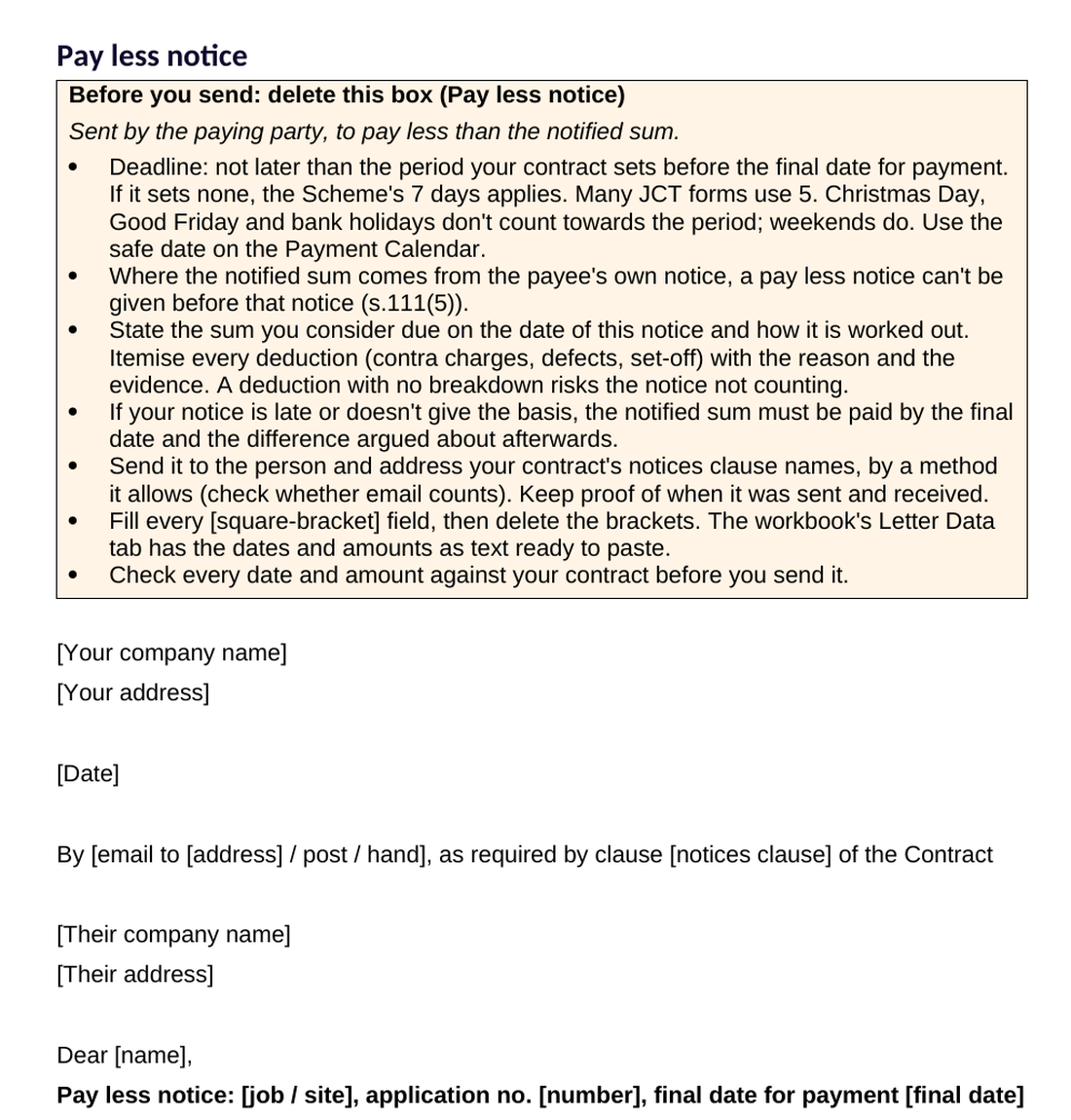
- Pay less notice: before the final date. If the payer wants to pay less than the notified sum, it must say so in a pay less notice, stating the sum it now considers due and the basis, no later than the agreed period before the final date, or the Scheme's 7 days (s.111).
- Final date for payment. The notified sum, or the pay less figure, must be paid by then (s.111(1)). The parties choose the gap between due date and final date.
- Not paid? From the day after the final date: statutory interest, the right to suspend on 7 days' notice, and adjudication.
| Step | What the Act requires | Scheme (contract silent) | JCT 2016 main-contract pattern |
|---|---|---|---|
| Due date | Set by the contract | Later of 7 days after the end of the period, or your claim | 7 days after the valuation date |
| Payment notice | Within 5 days of the due date | Within 5 days of the due date | Within 5 days of the due date |
| Final date for payment | Set by the contract | 17 days after the due date | 14 days after the due date |
| Pay less notice | The agreed period before the final date | 7 days before the final date | 5 days before the final date |
| Suspension notice | At least 7 days | At least 7 days | At least 7 days |
The Scheme figures are from Part II of the Scheme for Construction Contracts (England and Wales) Regulations 1998. The JCT figures are the pattern JCT describes for its 2016 main contracts; check your own sub-contract particulars before relying on them.
Counting days. Under s.116, a period "after or from" a date starts the next day, and Christmas Day, Good Friday and bank holidays are left out. Weekends are not. It isn't settled whether that rule also governs the periods written into your own contract, so we count each deadline both ways and use the safer one.
A worked example: one application, from valuation to suspension#
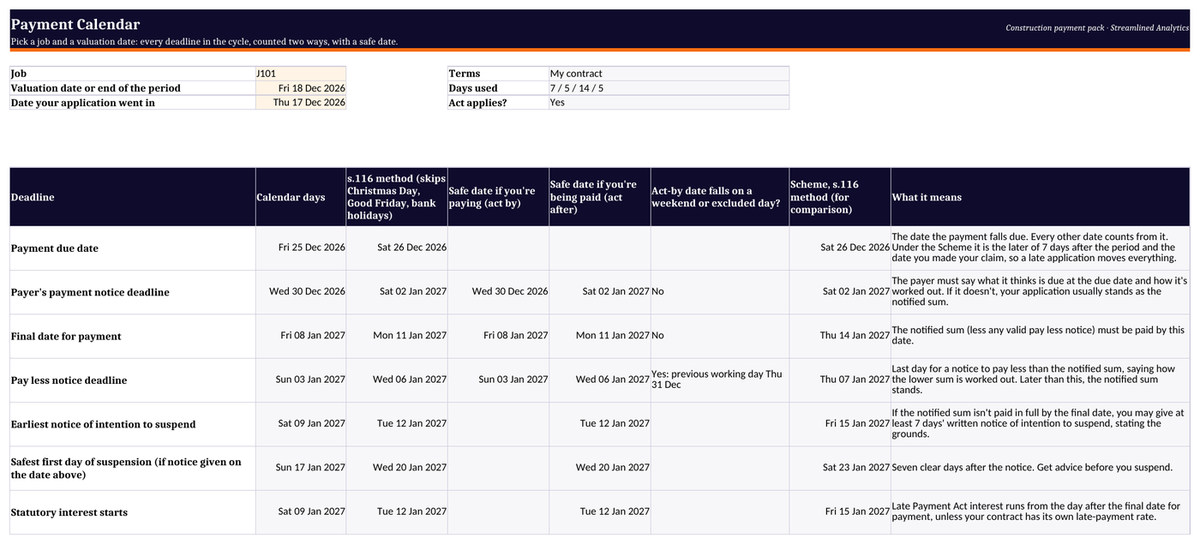
A fictional drylining subcontractor applies for £61,200 on job J101, valued on Fri 18 Dec 2026. Its sub-contract says: due 7 days after the valuation date, payment notice within 5 days of the due date, final date 14 days after the due date, pay less notice at least 5 days before the final date. Christmas Day is a Friday and the Boxing Day bank holiday moves to Mon 28 Dec, so the two ways of counting drift apart:
| Step | Calendar days | Skipping Christmas Day and bank holidays (s.116) | Safe date |
|---|---|---|---|
| Valuation and application (£61,200) | Fri 18 Dec | Fri 18 Dec | - |
| Due date | Fri 25 Dec | Sat 26 Dec | - |
| Payment notice by | Wed 30 Dec | Sat 2 Jan | Wed 30 Dec |
| Pay less notice by | Sun 3 Jan | Wed 6 Jan | Sun 3 Jan (Thu 31 Dec in practice) |
| Final date for payment | Fri 8 Jan | Mon 11 Jan | Late only after Mon 11 Jan |
| Interest starts; notice of intention to suspend can go | - | - | Tue 12 Jan |
| Earliest safe first day of suspension | - | - | Wed 20 Jan |
No payment notice came, and the application stood as the notified sum. The main contractor then served a pay less notice for £52,000 on Thu 7 Jan 2027, with no breakdown. That is late by both counts and gives no basis, so the full £61,200 was due by Mon 11 Jan. Our pay less notice guide works through that part in detail.
If the contract had been silent and the Scheme applied, the final date would be Mon 11 Jan by calendar days or Thu 14 Jan the s.116 way, and the pay less deadline Mon 4 Jan or Thu 7 Jan. Same job, three days' difference, which is why the pack shows the Scheme dates next to your contract's.
What does the Scheme for Construction Contracts fill in?#
The Scheme is a set of default terms. It isn't a contract you sign: its provisions apply automatically, but only to the extent your contract doesn't do what the Act requires (for example s.110(3) and s.113(6)). If your contract has a compliant payment mechanism, its own periods win. If it has none, or only part of one, the Scheme fills the gaps.
| Item | Scheme default (England and Wales) |
|---|---|
| Valuation period | As the contract says, otherwise 28 days |
| Interim payment due | The later of 7 days after the end of the period, or the payee's written claim |
| Final payment due | The later of 30 days after completion, or the claim |
| Final date for payment | 17 days after the due date |
| Payment notice | Within 5 days of the due date, with the sum and its basis |
| Pay less notice | At least 7 days before the final date |
| Adjudication (Part I) | How the adjudicator is appointed and how the adjudication runs, if the contract doesn't comply with s.108 |
One consequence catches people out: under the Scheme, the due date waits for your claim. A late application moves the due date, and every date after it, later.
What does the Construction Act ban?#
Some payment terms don't work, however clearly they are written:
- Pay when paid. A clause making your payment conditional on the payer being paid by someone else is ineffective, unless that party (or someone further up the chain) is insolvent (s.113). Your due date and final date stand whether or not the main contractor has been paid.
- Pay when certified, or when another contract is performed. Since 2011, a payment mechanism isn't adequate if it makes payment conditional on obligations under another contract being performed, or on someone deciding whether they have been (s.110(1A)). There are narrow exceptions, for example where the other contract is for carrying out the very work being paid for.
- A due date that waits for the payer's notice. A due date fixed by reference to a notice given to the payee about what is due, for example "due when the certificate is issued", isn't an adequate mechanism either (s.110(1D)).
- No final date. Every sum that becomes due must have a final date for payment (s.110(1)(b)).
When a term fails, the Act doesn't leave a hole: the parties can agree something else, and otherwise the relevant parts of the Scheme apply.
What can you do if you're not paid?#
If the notified sum isn't paid by the final date, you have four tools. They can be used together.
| Remedy | What you need | What it gets you |
|---|---|---|
| Suspend work (s.112) | At least 7 days' written notice of intention to suspend, stating the grounds | You can suspend any or all of your obligations until paid in full. Since 2011 the payer must cover your reasonable costs of suspending, and the time is added to your contract period |
| Adjudication (s.108) | A notice of adjudication, which you can give at any time | Adjudicator appointed and dispute referred within 7 days; decision within 28 days of referral (extendable by 14 days with your consent, or longer by agreement). Binding until the dispute is finally decided |
| Statutory interest (Late Payment Act 1998) | No clause needed, unless the contract has its own substantial late-payment remedy | 8% a year over Bank Rate, simple interest, from the day after the final date, plus £40, £70 or £100 fixed compensation per debt and reasonable recovery costs |
| Letter before action and court | A letter following the Pre-Action Protocol for Construction and Engineering Disputes | A court claim. The protocol need not be followed before a summary judgment claim or a claim to enforce an adjudicator's decision |
Claiming a notified sum the payer failed to challenge in time is often called a "smash and grab" adjudication. The payer can still argue about the true value of the work later, but the courts have said it generally has to pay the notified sum first.
For job J101, interest runs from Tue 12 Jan 2027. The rate is fixed by the Bank Rate on the 31 December before (SI 2002/1675, art. 4): if it stays at 3.75%, that's 11.75% a year, or £19.70 a day on £61,200. After 30 days, to Wed 10 Feb, that is £591.04 interest plus £100 fixed compensation: £691.04. Each interim payment is its own debt, so each late one carries its own fixed sum.
Suspension is a strong step, and it is suspension, not walking off the job. Get advice before you suspend or start a claim.
Common mistakes, and what they cost#
| Mistake | What actually happens |
|---|---|
| Pay less notice late, or with no basis | It doesn't count. The notified sum is payable in full by the final date |
| Payer gives no payment notice and the payee does nothing | If the application can't stand as the notice, the payee must give its own; the later it does, the later the final date (s.110B) |
| Relying on a pay-when-paid clause | Ineffective unless someone up the chain is insolvent (s.113) |
| Assuming supply-only work is covered | It isn't (s.105(2)(d)). No statutory notices, suspension or adjudication; the contract and the Late Payment Act still apply |
| Assuming a homeowner job is covered | It isn't, if the homeowner lives there or means to (s.106) |
| Suspending without proper notice | Without 7 days' written notice stating the grounds, a suspension can itself be a breach |
| Counting days wrongly over Christmas and Easter | A deadline missed by a day. Christmas Day, Good Friday and bank holidays don't count; weekends do (s.116) |
| Sending the application late under the Scheme | The due date waits for the claim, so every date moves later |
| Using today's Bank Rate for interest | The rate is fixed by the Bank Rate on the 30 June or 31 December before interest starts |
| Thinking there is no contract because nothing was signed | Oral and part-written contracts made since October 2011 are covered; the Scheme fills the gaps |
The law is also moving. The Commercial Payments Bill, before Parliament in October 2026, proposes changes including a ban on cash retentions in construction. It isn't law yet, and nothing in this guide depends on it.
Running the Construction Act every month, across every job#
One application is easy to get right. Twenty or thirty live jobs, each with a monthly valuation, a payment notice that may or may not come, a pay less deadline, a final date and a retention to chase, is where money slips. Most of the mistakes in the table above aren't legal misunderstandings. They are dates nobody was watching.
The applications tracker in the pack keeps every application on every job in one table: the notified sum, whether each notice from the other side arrived in time and gave a basis, what is payable, and what is overdue today.

The same figures, applied, assessed and paid, feed the value side of a monthly cost value reconciliation. Our free CVR template picks up from there. If you are also deducting or suffering CIS, our guides to calculating a CIS deduction, the domestic reverse charge and CIS payment and deduction statements cover the tax side of the same payments.
A spreadsheet is a good place to start. Where it breaks is the retyping: applications, notices and payments keyed in by hand from emails and your accounts, job by job. That is the work we build software to take out, with notices due and overdue money on a live dashboard instead. Book a short call and we will look at it on your own jobs, or start with the free construction payment pack.
This article is general information based on the Housing Grants, Construction and Regeneration Act 1996 as amended, the Scheme for Construction Contracts (England and Wales) Regulations 1998 as amended and the Late Payment of Commercial Debts (Interest) Act 1998, as at October 2026. It covers England and Wales. It is not legal, tax or financial advice. Check your contract and speak to a construction solicitor or adviser before relying on it, especially before you suspend work or start a claim.
FAQs
What is the Construction Contracts Act?
In England, Wales and Scotland, it usually means Part II of the Housing Grants, Construction and Regeneration Act 1996 (the Construction Act), as amended in 2011. It sets the payment and adjudication rules for construction contracts. Northern Ireland has the Construction Contracts (Northern Ireland) Order 1997, and Ireland has its own Construction Contracts Act 2013.
What contracts does the Construction Act apply to?
Contracts for construction operations in England, Wales or Scotland: building, civil engineering, installing systems, demolition, site preparation, painting and similar work, including subcontracts, labour supply, and architectural, design and surveying services. It doesn't apply to supply-only contracts, to a homeowner's contract for work on the home they live in, or to a few excluded industries.
What is the Housing Grants, Construction and Regeneration Act 1996?
An Act with several parts. Part I is about housing grants. Part II, "Construction Contracts", is the part the industry calls the Construction Act: stage payments, payment and pay less notices, the ban on pay-when-paid, the right to suspend and the right to adjudicate. It was amended by Part 8 of the Local Democracy, Economic Development and Construction Act 2009.
What is the Scheme for Construction Contracts?
A set of default terms made under the Act. If your contract doesn't provide what the Act requires, the relevant parts of the Scheme apply instead: for example, a final date for payment 17 days after the due date and a pay less notice at least 7 days before it. England and Wales and Scotland each have their own Scheme.
Does the Construction Act apply to supply-only contracts?
No. Making or delivering materials, components, plant or machinery to site isn't a construction operation unless the same contract also covers installing them (s.105(2)(d)). Supply-and-fix is covered. A supply-only supplier can still rely on its contract terms and on statutory late payment interest.
Does a construction contract have to be in writing?
Not since October 2011 in England and Wales. The old rule that the Act only covered written contracts (s.107) was repealed, so oral and part-written contracts are covered, and the Scheme fills in what the terms don't say.
Are pay when paid clauses legal in the UK?
Not in construction contracts covered by the Act. A clause making payment conditional on the payer being paid by a third party is ineffective unless that third party, or someone further up the chain, is insolvent (s.113).
How long does adjudication take?
The adjudicator must be appointed and the dispute referred within 7 days of the notice of adjudication, and must decide within 28 days of the referral. That can be extended by 14 days with the referring party's consent, or longer if both parties agree (s.108).
Can I charge interest on a late construction payment?
Usually yes. Under the Late Payment of Commercial Debts (Interest) Act 1998 you can claim 8% a year over Bank Rate from the day after the final date for payment, plus £40, £70 or £100 fixed compensation per debt, unless your contract has its own substantial late-payment remedy.
Keep reading
Pay less notice: the deadline, what it must say, and a free template (UK construction)
A pay less notice lets the paying side pay less than the notified sum, but only if it says how much and why, and arrives in time. The deadlines, how Christmas and bank holidays move them, a worked example and a free template.
13 October 2026 ReadFree cost value reconciliation template for Excel: what a spreadsheet does well, and where it breaks
A CVR template works fine for one project. Here is what it does well, the three things it cannot do, and how to tell which side of the line you are on.
18 July 2026 ReadHow to calculate a CIS deduction: the formula, a worked example and a free CIS calculator for Excel
CIS comes off the payment excluding VAT, less what the subcontractor paid for materials and hired plant. Here is the formula, a worked example, the five common mistakes and a free CIS calculator for Excel.
13 October 2026 Read