
The domestic reverse charge means a VAT-registered subcontractor does not charge VAT to a VAT- and CIS-registered customer for most construction services. The invoice still shows the VAT, says the reverse charge applies, and leaves the VAT out of the amount due; the customer pays it to HMRC through its own VAT return instead. It does not apply to end users who have told you so in writing, to householders and others who are not VAT-registered, or to zero-rated work.
What is the domestic reverse charge?#
Since 1 March 2021, for most building and construction services supplied between VAT-registered businesses in the CIS chain, the customer rather than the supplier accounts for the VAT. The supplier issues an invoice showing the VAT but does not collect it. The customer adds that VAT to the output tax on its own VAT return and, under the normal rules, reclaims it as input tax on the same return.
For most main contractors the two entries cancel out. For the subcontractor, the practical change is cash: you no longer receive the VAT and pay it over a month or a quarter later. HMRC's reverse charge technical guide suggests businesses that now reclaim more VAT than they pay consider monthly VAT returns.
When must you use the reverse charge?#
As the supplier, HMRC's guide says you must use it when all of these are true:
- Your customer is registered for VAT in the UK.
- The services are within the scope of the Construction Industry Scheme.
- The services are standard rated (20%) or reduced rated (5%).
- You are not an employment business supplying staff or workers.
- Your customer has not given you written confirmation that it is an end user or an intermediary supplier.
You also need to be VAT-registered yourself. A subcontractor who is not registered for VAT charges no VAT, so there is nothing to reverse.
| Situation | VAT treatment |
|---|---|
| VAT- and CIS-registered customer who sells the work on, e.g. a main contractor | Reverse charge |
| Customer has told you in writing it is an end user or intermediary supplier | Normal VAT |
| You think the customer is an end user, but it hasn't said so in writing | Reverse charge |
| Householder or other customer not registered for VAT | Normal VAT |
| Zero-rated work, e.g. building a new home | Zero-rated, no reverse charge |
| You are not VAT-registered | No VAT at all |
| You are an employment business supplying staff or workers | Normal VAT |
| Hire of equipment only, with no operator | Normal VAT (outside CIS) |
When doesn't the reverse charge apply?#
The common cases where you charge VAT normally, or not at all:
- Householders and other customers who are not VAT-registered. Where you clearly work for domestic customers, HMRC says you need not check their VAT or CIS status.
- Zero-rated work, such as most new-build housing.
- Employment businesses supplying staff or workers, even where the work is within CIS.
- Hire of equipment only. Hiring out scaffolding, mixers or a skip without an operator is outside CIS, so the reverse charge does not apply to the hire charge.
- End users and intermediary suppliers who have told you so in writing (below).
One trap catches a lot of subcontractors: a main contractor working for a householder is not an end user. Its own subcontractors still apply the reverse charge to it, even though the main contractor charges the householder VAT normally.
End users and intermediary suppliers#
An end user is a VAT- and CIS-registered business that does not sell the construction services on: a developer, a landlord or a retailer having its own premises fitted out, for example. An intermediary supplier is a VAT- and CIS-registered business connected or linked to an end user, such as a group company that procures building work for the rest of the group.
Neither is automatic. The customer has to tell you in writing. HMRC's guide suggests wording along these lines:
"We are an end user for the purposes of section 55A VAT Act 1994 reverse charge for building and construction services. Issue us with a normal VAT invoice, with VAT charged at the appropriate rate. We will not account for the reverse charge."
If you believe a customer is an end user but it has not said so in writing, HMRC says you should still apply the reverse charge. You can ask the customer to confirm, but it is not obliged to. Keep any notice on the job file: it is your evidence for charging VAT normally.
What must a reverse charge invoice say?#
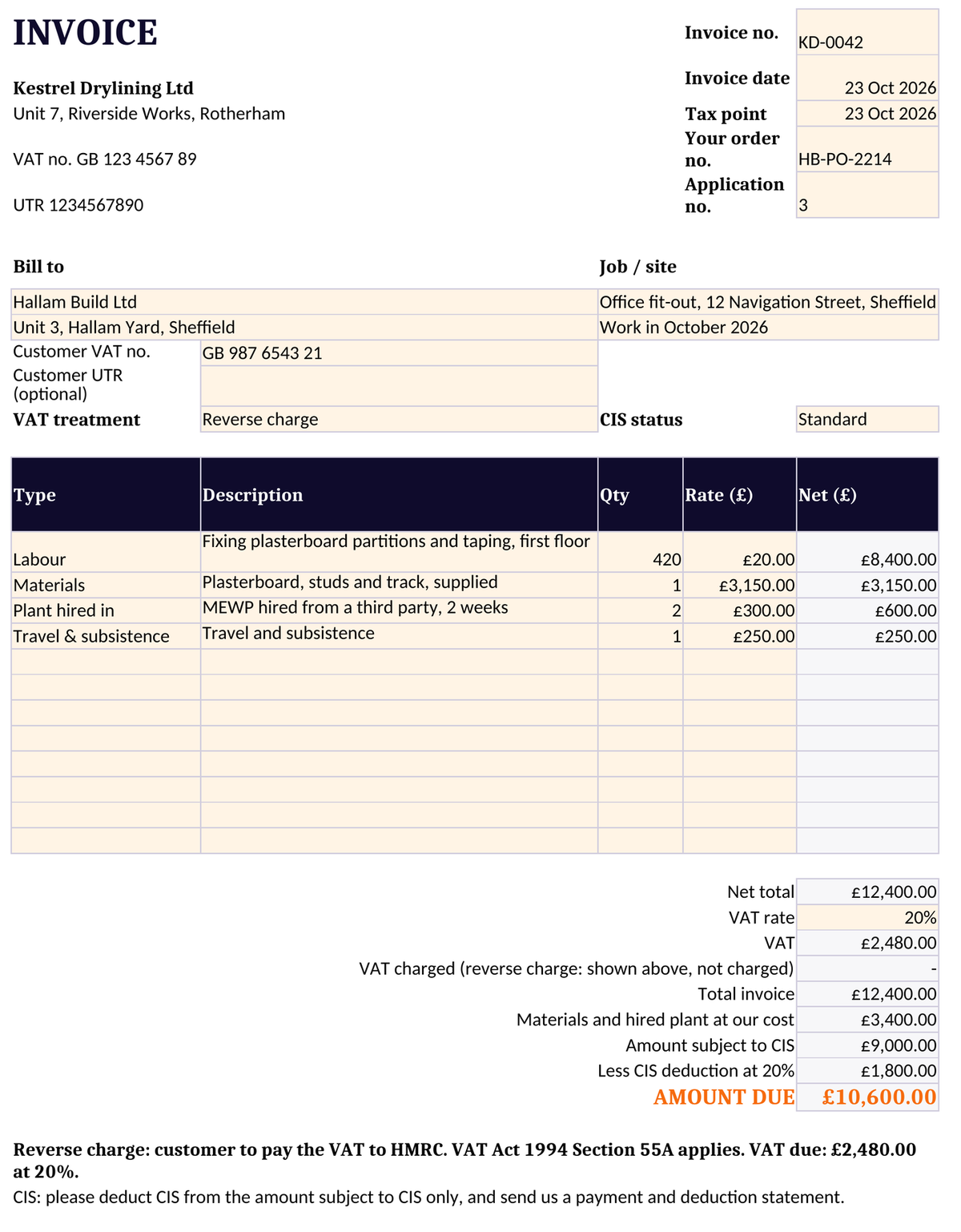
A reverse charge invoice is a full VAT invoice with three extra points:
- A note that the reverse charge applies. The VAT regulations require the reference "reverse charge". HMRC gives these as examples: "VAT Act 1994 Section 55A applies", "S55A VATA 94 applies" or "Customer to pay the VAT to HMRC".
- The amount of VAT due under the reverse charge, or the VAT rate if your software cannot show the amount.
- The VAT left out of the amount charged. The total you ask the customer to pay excludes it.
Everything else a normal VAT invoice needs still applies: your VAT number, an invoice number, the tax point, the customer's details, a description of the work and the net amounts.
A footer that covers all of it: "Reverse charge: customer to pay the VAT to HMRC. VAT Act 1994 Section 55A applies. VAT due: £2,480.00 at 20%."
How is VAT worked out on a reverse charge invoice?#
On the whole supply. Materials supplied with construction work are part of one supply, so the reverse charge applies to the full value of the invoice, labour and materials together. HMRC says labour and materials should not be split to keep the materials outside it, and on a supply and fix order the reverse charge covers the whole order even if you invoice the two parts separately.
The 5% disregard is the one exception. If the reverse charge part of a supply is 5% or less of the whole, it can be ignored, but only if that is agreed at the start of the contract on the overall contract values. It is never worked out invoice by invoice.
And VAT is worked out on the net invoice before CIS, never on the amount after the CIS deduction.
How the reverse charge and CIS work on the same invoice#
They are often confused because both are "20%", but they are separate. CIS is a deduction towards the subcontractor's own tax, taken from the labour part of the payment. The reverse charge decides who pays the VAT to HMRC. Here is the same £12,400 invoice under each treatment, with £3,400 of materials and hired plant at cost (the full sum is in our guide to calculating a CIS deduction):
| Reverse charge | Normal VAT | Sub not VAT-registered | |
|---|---|---|---|
| Net invoice | £12,400.00 | £12,400.00 | £12,400.00 |
| VAT at 20% | £2,480.00 shown, not charged | £2,480.00 charged | None |
| CIS deduction at 20% | £1,800.00 | £1,800.00 | Recalculate* |
| Amount due | £10,600.00 | £13,080.00 | Net less CIS |
| Who pays the £2,480 VAT to HMRC | The customer | You | Nobody |
*If you are not VAT-registered, the VAT you paid on materials is part of your cost, so the materials figure, and with it the deduction, changes.
One warning if you check your figures against HMRC's own CIS guide: the worked examples in CIS 340's Appendix D still show a VAT-registered subcontractor charging VAT to the contractor in the normal way. They pre-date the reverse charge. Since March 2021 most of those payments would be reverse charged.
Your VAT return, cash accounting and the Flat Rate Scheme#
- As the supplier, you enter only the net value of a reverse charge sale on your VAT return, with no output tax.
- As the customer, you add the VAT to your output tax, reclaim it as input tax under the normal rules, and do not enter the net value as a sale.
- Cash accounting cannot be used for reverse charge supplies, bought or sold.
- Flat Rate Scheme users leave reverse charge sales out of the flat rate turnover. If you buy reverse charge services, you account for the VAT and recover it on the same return.
Our free CIS invoicing pack handles the VAT treatment and the CIS deduction together, and contractors get a payment log that feeds the monthly payment and deduction statement.
If your team rebuilds every invoice by hand from quotes and job sheets, then keys it into your accounts again, that retyping is the kind of admin we build software to take out. Book a short call and we will look at it on your own jobs.
This article is general information based on HMRC guidance as at October 2026. It is not legal, tax or financial advice. Check the rules on GOV.UK or speak to an accountant or adviser before relying on it.
FAQs
Who pays the VAT under the domestic reverse charge?
The customer. It accounts for the VAT on its own VAT return and usually reclaims it on the same return. The supplier shows the VAT on the invoice but does not charge it.
Does the reverse charge apply to work for homeowners?
No. Householders are not VAT-registered, so you charge VAT in the normal way. But subcontractors working for a builder on a domestic job still reverse charge the builder.
What wording should a reverse charge invoice have?
A reference to the reverse charge, such as "Reverse charge: customer to pay the VAT to HMRC" or "VAT Act 1994 Section 55A applies", plus the amount of VAT due, left out of the total charged.
Does the reverse charge apply to materials?
Yes, when they are supplied with the construction work. The reverse charge covers the whole invoice, labour and materials together.
Does the reverse charge apply if I'm not VAT-registered?
No. If you are not registered for VAT you do not charge VAT, so there is nothing to reverse charge. CIS still applies.
Does the reverse charge change the CIS deduction?
No. CIS is calculated on the payment excluding VAT, so the deduction is the same whether VAT is reverse charged or charged normally. Only the amount due changes.