
A CIS invoice is a subcontractor's invoice that splits labour from materials, shows the CIS deduction the contractor should take and, between VAT-registered businesses, the reverse charge VAT. The payment and deduction statement is the contractor's reply: a written record of what it paid and deducted in each tax month, due to the subcontractor by the 19th. The contractor files its monthly return by the 19th and pays the deductions to HMRC by the 22nd.
What should a CIS invoice include?#
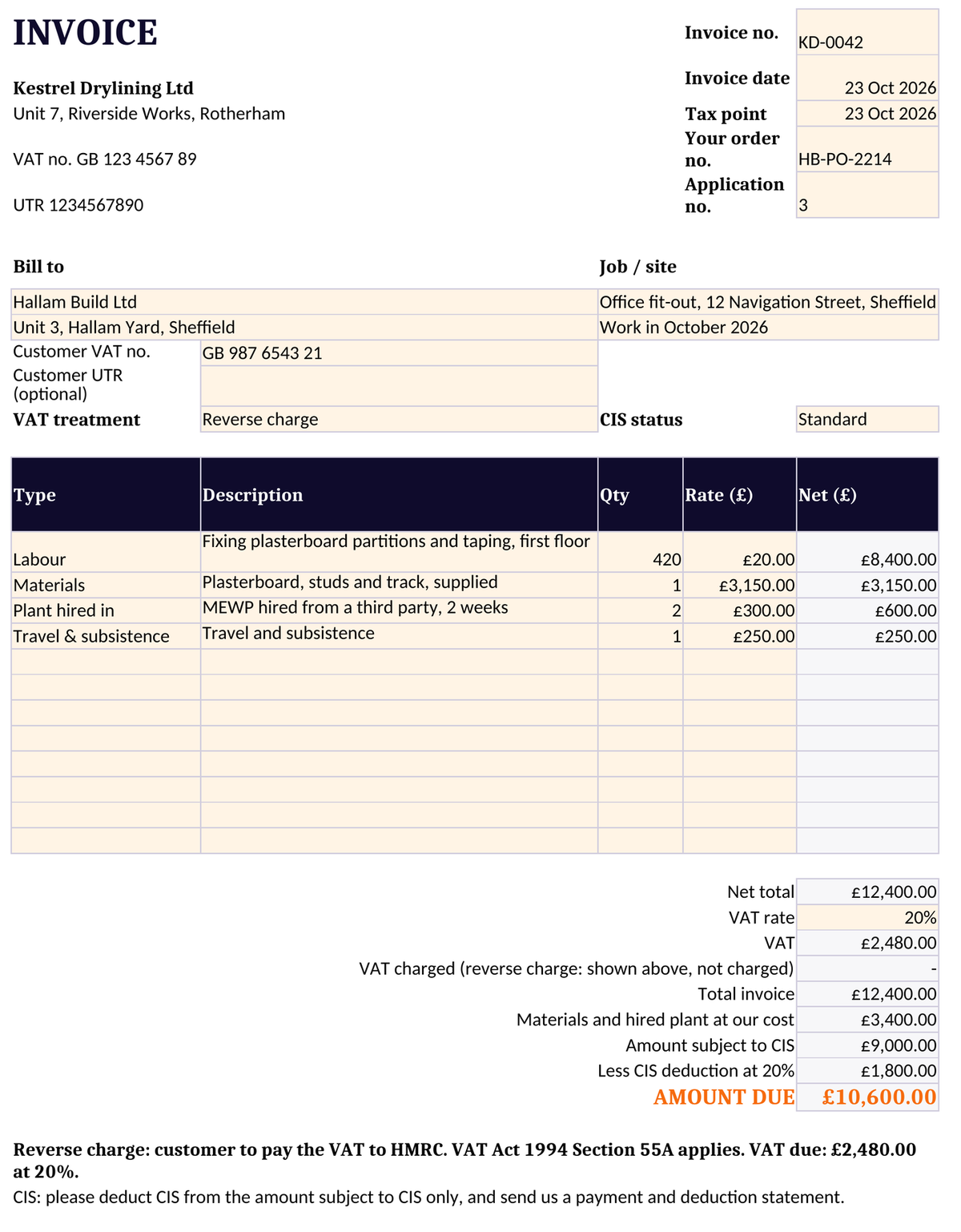
There is no special HMRC form for a CIS invoice. It is a normal invoice, or a full VAT invoice if you are VAT-registered, laid out so the contractor can make the right deduction. A good one has:
- Lines split by type: labour, materials, plant hired from a third party, your own plant, and travel and subsistence. The contractor needs the split to work out the deduction.
- The cost of materials and hired plant, or be ready to give it. CIS comes off what you paid, not what you charged, and the contractor may estimate it if you won't say.
- Your UTR and company name exactly as registered for CIS, so the statement matches what HMRC holds.
- The VAT treatment: the reverse charge wording and VAT amount, normal VAT, or none.
- The CIS deduction and amount due. The contractor makes the deduction, but showing your figure makes it easy to agree and to spot a wrong one.
How the deduction is worked out, line by line, is in our guide to calculating a CIS deduction, and the VAT wording is covered in our domestic reverse charge guide.
What is a CIS payment and deduction statement?#
It is the contractor's written record, for one subcontractor, of the payments made and the CIS deducted. For the subcontractor it is the proof that tax has already been paid on its behalf, a bit like a payslip. A limited company needs the statements to offset the deductions against its PAYE bill, and a sole trader needs them for Self Assessment. Without them, claiming the money back gets harder.
The contractor must give a statement to every subcontractor it made a deduction from (CIS 340, 3.15). For subcontractors paid gross, with nothing deducted, a statement is not required, though many contractors send one anyway.
What must the statement show?#
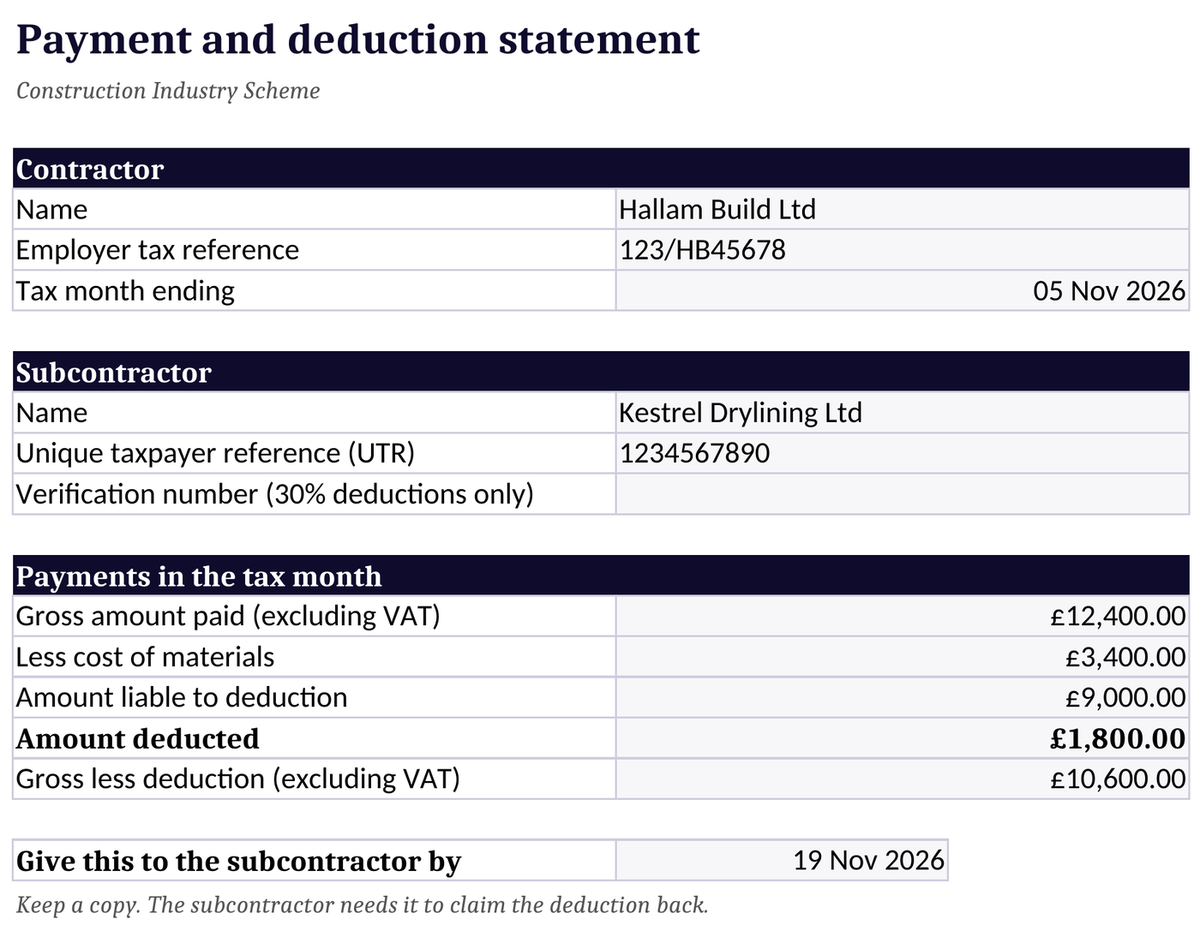
CIS 340 (3.15 and Appendix E) lists the contents:
- The contractor's name and employer tax reference.
- The tax month the payment was made in, for example "tax month ending 5 November 2026", or the payment date if you issue one statement per payment.
- The subcontractor's name and UTR.
- The verification number, but only if the deduction was at the 30% higher rate.
- The gross amount paid, excluding VAT.
- The cost of materials the deduction was not taken from.
- The amount deducted.
VAT can be shown for clarity, but it is not required. A replacement copy should be marked "Duplicate".
When should CIS statements be issued?#
Within 14 days of the end of the tax month, which means by the 19th. The CIS tax month runs from the 6th of one month to the 5th of the next. You can send one statement per tax month covering every payment, or one per payment, and it can be electronic if the subcontractor agrees and can print it.
The same date drives the rest of the contractor's month:
| What | When | Example: paid Wed 28 Oct 2026 |
|---|---|---|
| Tax month | 6th of one month to the 5th of the next | 6 Oct to 5 Nov 2026 |
| Payment and deduction statement to the subcontractor | By the 19th (within 14 days of the tax month end) | Thu 19 Nov 2026 |
| Monthly return (CIS300) to HMRC | By the 19th | Thu 19 Nov 2026 |
| Pay the deductions to HMRC | By the 22nd if paying electronically (19th by post); the banking day before if the 22nd is a weekend or bank holiday | Fri 20 Nov 2026 (the 22nd is a Sunday) |
Two more points for contractors. Since 6 April 2026, a contractor that paid no subcontractors in a tax month has to file a nil return again, or tell HMRC it is inactive. And if your average monthly payments to HMRC are under £1,500, you may be able to pay quarterly instead (CIS 340, 4.12).
CIS follows the payment, not the invoice#
Statements and returns are based on payments made in the tax month (CIS 340, 2.16 and 4.2). An invoice dated 23 October and paid on 28 October falls in the tax month ending 5 November. If it were paid on 9 November, it would move to the month ending 5 December, with a statement due by 19 December.
The same rule governs the awkward items. A retention is subject to CIS when it is paid out, at the subcontractor's status at that date. A set-off for defective work reduces the gross figure on the statement; a contra charge for skips or welfare does not (CIS 340, 6.11 and 6.13).
If you run a monthly cost value reconciliation, the same split matters there: CIS deducted is cash, not cost. Our free CVR template treats it that way, and our guide to CVR explains why.
Contractors: the payment log behind the statements#
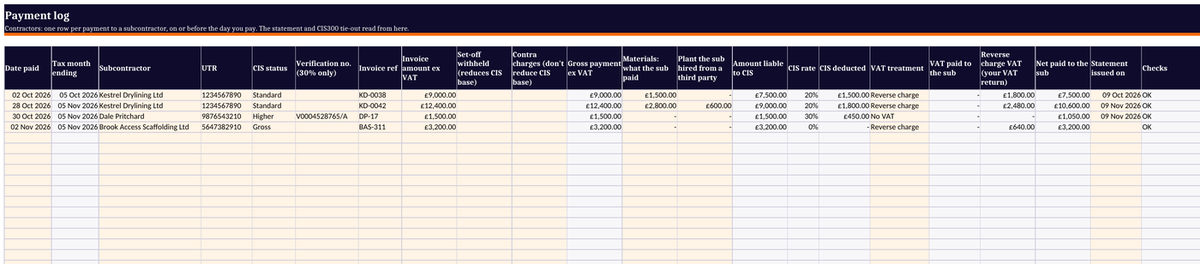
CIS 340 (3.18) asks contractors to record, on or before each payment, the gross amount excluding VAT, the cost of materials (excluding VAT if the subcontractor is VAT-registered) and the deduction. Keep those three figures in one log, one row per payment, and the statements and the CIS300 come straight out of it rather than being rebuilt from bank statements on the 18th.
What if your contractor hasn't sent a statement?#
Ask for it in writing, quoting the payment dates and amounts. The contractor is required to provide it. In the meantime, keep your invoices, remittance advices and bank statements showing what was paid, so your accountant can support the claim.
If the figures on a statement don't match your invoice, check the materials figure first. A contractor that took materials at a different figure, or treated travel as materials, will have deducted a different amount, and the place to fix that is with the contractor before year end.
If your team retypes the same job into a quote, an invoice, your accounts and the CIS figures every month, that is the kind of admin we build software to take out. Book a short call and we will look at it on your own jobs.
This article is general information based on HMRC guidance as at October 2026. It is not legal, tax or financial advice. Check the rules on GOV.UK or speak to an accountant or adviser before relying on it.
FAQs
What is a CIS payment and deduction statement?
A written statement from a contractor to a subcontractor showing the gross paid, the cost of materials and the CIS deducted in a tax month. It is the subcontractor's proof of tax already paid.
When should CIS statements be issued?
Within 14 days of the end of the tax month, so by the 19th. The tax month runs from the 6th to the 5th.
Do subcontractors with gross payment status get a statement?
It is not required when nothing was deducted, but sending one is good practice.
What is the difference between a CIS invoice and a CIS statement?
The subcontractor sends the invoice, asking to be paid. The contractor sends the statement afterwards, recording what it actually paid and deducted.
Where can I find a template for a CIS deduction statement?
HMRC publishes a basic form. Our free CIS invoicing pack fills in the statement from a payment log and shows the date it is due.
When must contractors pay CIS deductions to HMRC?
By the 22nd after the tax month if paying electronically, or the 19th by post. If the 22nd falls on a weekend or bank holiday, pay by the banking day before.